Following this week's workshop on potential sites for the 2020 rover landing, the list has narrowed to eight candidates. The journal Science has a nice article summarizing the outcome. If you'd like to peruse the presentations from the workshop, they are available here. Jezero Crater won the vote among scientists at the workshop, but there are plenty of other favorites that have returned from the list of candidates considered for the Curiosity rover and in consideration for the 2018 ExoMars rover: NE Syrtis, Eberwalde, SW Melas, Nili Fossae Trough, and Mawrth. The biggest surprise for me was that the second most popular site was to return to the Columbia Hills explored by the Spirit rover to further examine its hydrothermal vents.
These eight semi-finalist sites will be further studied leading to a workshop in 2017 where the list will be narrowed to four and eventually to the one site where the rover will land and explore. The advocates for each of these sites now will work to put together the evidence to make their site the eventual selection.
Friday, August 7, 2015


Wednesday, August 5, 2015
Correction: No descent camera on the Mars 2020 rover
Since I published my short update on the Mars 2020 plans, I've learned that the current plans for the mission do not include a descent imager. As a result, there currently will not be the equivalent to the descent movie made for the Curiosity landing. I apparently misunderstood a point on an earlier presentation I read.
The project engineers are still evaluating a Terrain Relative Navigation system to guide the rover to a safe landing. That system would require a down looking camera. I have not heard whether that camera would make movies or record still images for later analysis or release to the public.
The project engineers are still evaluating a Terrain Relative Navigation system to guide the rover to a safe landing. That system would require a down looking camera. I have not heard whether that camera would make movies or record still images for later analysis or release to the public.
Tuesday, August 4, 2015
Update on NASA Mars Rover Plans
Corrections: Since original post, I've learned that there currently is no plan to include a descent imager to record the landing as was done for the Curiosity rover. I also accidentally used an image showing the cameras on the Mars Exploration Rovers Spirit and Opportunity instead of Curiosity, and this has now been corrected.
The second in a series of meetings to select the landing site for the Mars 2020 rover is in progress. At these meetings, the project's engineers describe the engineering capabilities and constraints on the mission and scientists describe their favorite sites for the rover to explore. Final selection of the landing site is several year away, but these meetings are good ways to catch up on the current plan for the mission. You can find all the presentations for this meeting here.
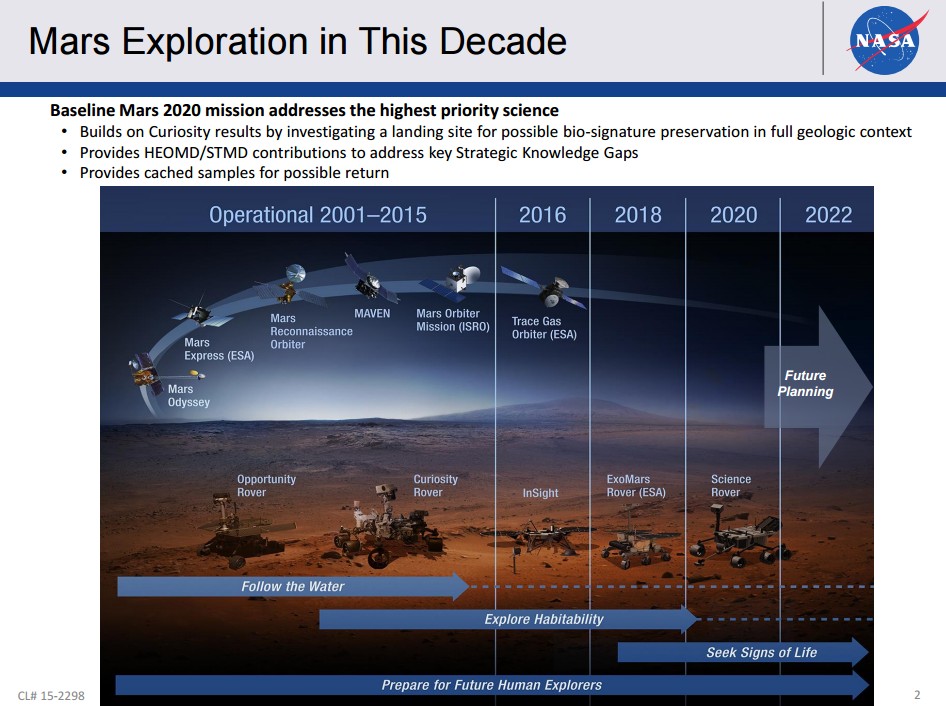
The Mars 2020 rover will be the sixth rover on Mars following the tiny Sojouner rover in 1997, the Spirit and Opportunity rovers (the latter still going strong), the Curiosity rover now at Mars, and the European-Russian Mars 2018 ExoMars rover. Each succeeding rover becomes more progressively focused on exploring the past and present habitability of the Red Planet.
The Mars 2020 rover will carry a new generation of instruments to explore Mars. I covered these in some depth when the instrument selection was announced last year (see here).
A single slide provides an update on the mission's development. The top half of the slide provides details that essentially mean that the engineering is progressing smoothly and advancing from one stage to the next. The news begins with the rover systems/project update.
This mission will carry a new camera to record the landing. the Mars 2020 rover will carry a camera to look upward to record the deployment of the parachute.
The Curiosity rover carried on the bottom of the rover body to look down and shoot a movie of the descent and landing (for a refresher on that movie, see here). Currently, there is no plan to have a similar camera for the 2020 rover (but see below).

The second in a series of meetings to select the landing site for the Mars 2020 rover is in progress. At these meetings, the project's engineers describe the engineering capabilities and constraints on the mission and scientists describe their favorite sites for the rover to explore. Final selection of the landing site is several year away, but these meetings are good ways to catch up on the current plan for the mission. You can find all the presentations for this meeting here.
 |
| Credit: NASA/JPL-CALTECH |
 |
| Credit: NASA/JPL-CALTECH |
The Mars 2020 rover will carry a new generation of instruments to explore Mars. I covered these in some depth when the instrument selection was announced last year (see here).
 |
| Credit: NASA/JPL-CALTECH |
This mission will carry a new camera to record the landing. the Mars 2020 rover will carry a camera to look upward to record the deployment of the parachute.
The Curiosity rover carried on the bottom of the rover body to look down and shoot a movie of the descent and landing (for a refresher on that movie, see here). Currently, there is no plan to have a similar camera for the 2020 rover (but see below).
 |
| The location of the navigation and hazard detection cameras on the Curiosity rover. On the 2020 rover, the Mastcam-Z cameras will replace the Mastcam cameras. Credit: NASA/JPL-CALTECH |
 |
| Hazcam image taken shortly after Curiousity landed on Mars. Credit: NASA/JPL-CALTECH |
In addition to the two stereo zoom science cameras (the Mastcan-Z cameras), the 2020 rover will carry a number of engineering cameras used to plan rover traverses and to look for hazards. On the Curiosity rover, these cameras take black and white images. On the Mars 2020 rover these cameras will take color images and have improved resolution.
 |
| Curiosity selfie taken taken by its MAHLI microscopic imager. Credit: NASA/JPL-CALTECH |
The Curiosity rover carries a microscopic camera that is also able to focus to infinity enabling it to examine the rover's wheels as well as take selfies. On the 2020 rover, there won't a dedicated microscopic instrument, but two instruments include microscopic cameras. One of these in the SHERLOC composition instrument will be upgraded from its initial design to one similar to that carried by the Curiosity rover.
The final instrument news is that the ground penetrating radar unit, RIMFAX, is now formally a part of the instrument compliment follow an engineering assessment on whether it could be accommodated within the rover.
The last remaining major engineering design question that I'm aware of is whether or not the 2020 rover's descent system will include a Terrain Relative Navigation (TRN) system. If included, it would use descent images to calculate the rover's position relative to a map stored on board to allow the descent stage to steer the rover to a safe landing spot. Many of the most interesting scientific sites have just a few, relatively small safe spots within landscapes of more challenging terrain. Including this capability would open more sites to the mission for consideration. The project has yet to decide on whether it will include this capability. If the TRN system is added, then there will be a camera to image the descent. I haven't heard whether these would be still images or movies or whether they would be saved for later analysis and release to the public.
 |
| Credit: NASA/JPL-CALTECH |
One of the primary goals for the 2020 rover will be to cache samples for a future mission to collect and place inside an ascent stage (essentially a small rocket) that would carry the samples to Mars orbit for collection by another spacecraft that would return them to Earth. A slide shows three concepts for these follow on rovers and landers. Two would carry the ascent stage in a tube on a large rover. A third concept would have the ascent stage on a stationary lander and use a small fetch rover to collect and return the cached samples. This follow on mission is not yet approved or funded, and may follow the 2020 rover by a number of years if it is flown.

Friday, July 24, 2015
Discovery Proposals to Explore the Solar System’s Smallest Worlds
Minor corrections were made to the previous version of this post. Launch for the selected mission will need to happen by the end of 2021, not 2020. Also, one previous space telescope, the Kepler mission to search for planets around other stars was also selected under the Discovery program although it was later moved to NASA's astrophysics program.
This summer, NASA’s managers are in the delightful position of having a tough choice to make.
This summer, NASA’s managers are in the delightful position of having a tough choice to make.
For the space agency’s lowest cost planetary missions, known as
Discovery missions, NASA’s managers ask the planetary science community to
propose the missions they’d like to see fly.
Any solar system body except the sun and Earth (both covered under other
programs) can be targeted. (Missions to study planets around other stars are also funded through other programs.) There’s a
strict cost cap of $450M for the spacecraft and instruments, with the agency separately
picking up other costs such as the launch and mission operations.
The competitions are extremely competitive, with a single mission
selected every few years from what’s typically a field of 25 to 30
proposals. Because it’s common to
resubmit proposals in the next competition, in the past, proposers often have
been reluctant to even give the names of their missions and only a few released
any details of the concepts. Why give
your competitors ideas for their next proposal?
For the Discovery competition in progress, the thirteenth, that near
silence has been broken and most teams have published or presented summaries
(and in at least one case, nearly a full description) of their proposed
missions. We now know at least the names and destinations for 24 of the 28 proposals. I am delighted with the
creativity and quality of the ideas. I suspect
that NASA’s managers are equally impressed and find themselves having to make a
tough choice this summer among a number of top-notch proposals.
 |
| Images of all the comets and asteroids imaged by spacecraft except the much larger Vesta and Ceres. The moons of Mars also are not shown. Credit: Montage by Emily Lakdawalla. Data from NASA / JPL / JHUAPL / UMD / JAXA / ESA / OSIRIS team / Russian Academy of Sciences / China National Space Agency. Processed by Emily Lakdawalla, Daniel Machacek, Ted Stryk, Gordan Ugarkovic. |
My understanding of the selection process is that each proposal is
evaluated twice for the initial round of selection. First, teams of scientists review the
scientific merits of the proposals and rank them. Second, teams of engineers review the
proposals for technical feasibility and likelihood of be able to be built
within the cost cap. The very few
proposals that receive top scores in both evaluations become eligible to be
selected as finalists that receive funding for a year to more fully develop
their concepts (typically three proposals in recent competitions). Approximately a year later, NASA’s associate administrator for science makes the ultimate selection from among the finalists. Launch of the selected mission is expected by 2020.
The openness of the proposing teams for the current competition allowed
James Callahan to publish brief
summaries of most of the proposals. I’ve
published fuller
descriptions for the four proposals for missions to study the outer planets,
as well as more detailed descriptions of a proposed
mission to a metallic asteroid and a mission to remap
Venus with modern instruments. (While
the latter focused on a European proposal for their own mission competition, at
least two teams reportedly have submitted similar proposals for the current
Discovery competition.)
At a meeting of the Small Bodies Assessment Group at the end of June,
scientists proposing missions to the solar system’s comets and asteroids gave 10
minute summaries of their proposals. In
this post, I’ll report on the concepts presented.
The key to thinking about the small body Discovery proposals is to
understand how diverse these worlds are.
They lay scattered from the inner solar system to the edge of
interstellar space. Some are rich in
volatiles and are commonly called comets.
Some are almost all rock and are called asteroids. Some (like Ceres where the Dawn spacecraft
now orbits) are mixtures of both and we don’t yet have a good name for
them. Within these broad classes of
objects, they show tremendous diversity in size, shape, and composition.
To understand the clues these bodies provide on the solar system and
its formation, we need to explore a few of them in depth to tease out their
subtle details. We also need to observe
many more with less detail to build up a statistical understanding of their
diversity. Each of the small body Discovery
mission proposals plays to one or the other of these strategies.
Comet missions
Depending on how you define a comet, either three or four teams propose
missions to rendezvous with a comet and explore their target in depth. Several spacecraft have made quick
observations of comets during the minutes surrounding closest approach during
high speed flybys. The Rosetta
spacecraft and its lander Philae are currently conducting a lengthy in-depth
exploration of comet 67P/Churyumov–Gerasimenko.
All four of the Discovery comet missions would rendezvous and then
orbit their comet for long-term studies.
Unlike the Rosetta spacecraft, these missions would carry just a few
selected instruments for focused studies.
The Rosetta mission has cost approximately 1.4 billion Euros (~$1.5B)
and carries 11 instruments on the orbiter and another ten on its Philae lander. To fit within the $450M cost cap of a
Discovery mission, these missions have to carefully target just one or two
questions with as few as two instruments.
 |
| Comet Hartley 2 imaged during a brief flyby by the EPOXI/Deep Impact spacecraft. Credit: NASA/JPL-CALECH |
Interestingly, two missions propose to study the same comet, the 2.3
kilometer long Hartley 2
that was previously visited by the Deep Impact EPOXI spacecraft during a brief
flyby in 2010. The choice of the target
may owe partially to the chance alignment of its orbit with Earth around 2020
allowing an easy flight. However, the
comet itself is interesting with highly active jets emitting water vapor from
one part of the surface and carbon dioxide and ice from another. Both the CHagall mission and the Primitive
Material Explorer would orbit the comet and study the structure and composition
of its surface with cameras and an infrared spectrometer. A mass spectrometer would taste the gases
jetting from the surface to analyze their composition including measuring the
fractions of key isotopes that provide compositional clues to the formation of
the solar system. The CHagall spacecraft
would place small explosive charges on the surface to expose fresh subsurface
material. The PriME spacecraft would
carry an additional ion and electron spectrometer to further analyze the
material emitted from the comet. While
the primary science questions for the Chagall are to understand the formation
and heterogeneity of comets, the primary question for the PriME mission is to
determine whether comets such as Hartely 2 could have delivered water to the
Earth.
In the last Discovery competition, a mission proposal similar to CHagall,
CHOPPER,
was the one of the three finalists (but not chosen). PriME, too, competed last time, and while the
mission was not a finalist, its MASPEX
mass spectrometer was funded for further development. MASPEX was selected for NASA’s mid-2020’s Europa
mission and is proposed to be included by several of this Discovery
competition’s proposed missions.
The Proteus
mission would visit 238P/Read,
a small body within the asteroid belt that behaves like a comet and are known
as main belt comets. The spacecraft
would make slow flybys past this 0.4 km radius world before entering
orbit. This mission would carry just two
instruments, a copy of the Dawn spacecraft's camera and the MASPEX mass
spectrometer. Like the PriME mission,
this mission would focus on determining whether comets like this could be the
source of Earth’s water as well as seek clues in its composition as to where it
formed in the solar system.
The final comet mission would also orbit a comet, this time 10P/Tempel
2 (which should not be confused with the more famous Tempel 1 comet that has
had two spacecraft flybys). This
mission, though, carries no instruments to measure composition. Its focus is on the structure of the comet
from its surface to its center. A camera
(another copy of the DAWN instrument) would map the surface morphology, and an
infrared imager will study how the surface heats and cools to determine its
properties (for example, a hard solid or a fluffy dust pile). The main instrument, as the mission’s name –
the Comet Radar Explorer (CORE) – suggests would be an ice-penetrating radar
that would see into the depths of the comet to give it the equivalent of a CAT
scan. The data would allow scientists to
determine how the comet came together (large chunks or small snow balls) and
would map the distribution of ices, rocky material, and voids. (Similar ice penetrating radars are operating
on two spacecraft at Mars, and the JUICE and Europa missions will use them to
study Ganymede and Europa next decade.)
Asteroid orbiters
Scientists are proposing four missions that would orbit asteroids
ranging from those in near Earth orbits to asteroids that share an orbit with
Jupiter. The Binary
Asteroid in-situ Explorer (BASiX) shares similar goals with CORE –
understand the structure of a tiny asteroid (1.7 km 1996 FG3) at its tinier
(0.5 km) moon. Both bodies are likely
aggregates (a nice way to say rubble pile), but scientists are unclear as to
how they form, how they are structured, and how they have changed through
time. While larger bodies have
substantial gravity to hold them together, these are worlds of
microgravity. The BASiX spacecraft would
image these worlds, measure the surface properties with thermal imaging, and
study the interior through gravity studies.
Small explosive pods along with geophones would be placed on the surface
to study the interior from the seismic waves created by the explosions.
 |
| Credit: Peter Rubin/JPL-CALTECH. |
If tiny worlds are rubble piles, the Psyche
mission could explore the opposite end of the spectrum – a metal asteroid
that may be the solid remnant core of a shattered proto world. The deep core of our world,
the other terrestrial worlds, and the larger asteroids remains hidden beneath
layers of rock. One or more ancient
impacts may have blasted these layers off the surface of the asteroid 16 Psyche. This mission’s spacecraft would
image the surface, map its composition, and study the interior through gravity
studies. Its scientists may find the
intact core of a young world, a core broken into a rubble pile, or a metal
world that formed directly through accretion without a rocky surface. One of the primary goals of this mission will
be to determine what this world is and what it can say about the formation of
the interior of larger rocky worlds.
The Advanced
Jovian Asteroid Explorer (AJAX) spacecraft would journey beyond the
asteroid belt to the Trojan
asteroids that share Lagrangian orbits with Jupiter. Scientists have two theories about how these
asteroids formed, which based on their colors are different than other asteroid
populations. The Trojan asteroids may
have formed from the same cloud of dust and gas as Jupiter. Or, thanks to the planetary migration in the
early solar system, they may have formed from beyond the orbit of Neptune and
later been captured into their present orbits.
Either way, they could tell us much about conditions in the outer solar
system early in its history. AJAX would
orbit a 32 km diameter D-type Trojan asteroid (I didn’t catch the name) and map
its surface morphology and composition.
It would also place a lander with mobility (a hopper? a wheeled rover?)
on the surface for more precise composition measurements. The mission also has an option to flyby a
second Trojan asteroid.
The mission proposal for which I have the least information is the Dark
Asteroid Rendezvous (DARe). No
slides were presented at the SBAG meeting.
It would orbit multiple asteroids – it’s not clear if these are
near-Earth or in the main belt or both – that are the rarer and likely more
primitive D- and P-Types. The spacecraft
would carry copies of the DAWN cameras (this design is popular), instruments to
map composition of the surface, and a radar.
Martian Moons
 |
| Phobos as viewed by NASA’s Reconnaissance Orbiter. Credit: NASA-JPL/CALTECH |
Mars’ two tiny moons, Phobos and Deimos, are favorites
for Discovery competitions (and their European counterpart) for several
reasons. First, there is the mystery of
their origin. Are they captured asteroids
(in which case their color suggests they may be rare primitive bodies)? Are they material left from the formation of
Mars? Or are they material blasted into
orbit from asteroid strikes on Mars’ surface?
Any of these choices makes them interesting scientific targets. A second reason for the interest is that
these moons may serve as initial targets for human exploration as we build the
skills and technologies to enable missions to the surface of Mars. And third, transits to Mars and therefore its
moons are relatively easy.
For this competition, three teams are proposing missions to these moons
using three distinct strategies. The Phobos and Deimos
and Mars Environment (PADME) would be a small spacecraft that would orbit
Mars and make 16 flybys of Phobos and 9 of Deimos. The craft would carry a suite of cameras that
would take images with resolutions as small at 2.8 centimeters to study fine
scale features and the processes that formed them. During the flybys, a neutron spectrometer
would remotely measure surface composition while a mass spectrometer would
directly measure the composition of surrounding dust particles ejected from the
surface. Tracking the radio signal during
flybys would provide information on the gravity field and therefore the
interior structure of the moons.
The Pandora
mission, in contrast, would use a solar electric propulsion system (similar
to that used on the DAWN spacecraft currently at the asteroid Ceres) to enable
it to orbit each of the moons for extended studies. The Pandora mission would use cameras, a near
infrared spectrometer, and a gamma ray neutron spectrometer to remotely study
the surface as well as radio tracking.
Unlike PADME, Pandora wouldn’t carry a mass spectrometer to directly
measure the composition of dust ejected from the surface. That type of measurement requires high
relative speeds so that the dust vaporizes on impact with the instrument to
enable the composition to be determined.
PADME’s flybys would provide the relative speed necessary while
Pandora’s slower relative motion in orbit likely would not. This is an example of the types of tradeoffs
that mission proposers must make – PADME’s simpler mission design enables a
valuable measurement while Pandora’s mission design enables longer and more
detailed measurements with other instruments.
(This mission proposal is in many ways similar to NASA’s
possible 2020s Mars orbiter that also would use solar electric
propulsion. On its way to its close in
orbit around the Red Planet, NASA has discussed that its future Mars orbiter
could visit and orbit Deimos and Phobos.
The Pandora team would transfer their spacecraft to the Mars program at
the end of their mission. However, the
Pandora spacecraft would lack the ultra-high resolution camera and atmospheric
instruments that the Mars program would want for a dedicated mission.)
 |
| Deimos as viewed by NASA’s Reconnaissance Orbiter. Credit: NASA-JPL/CALTECH |
The final mission proposed for these moons, the Mars-moons
Exploration, Reconnaissance, and Landed Investigation (MERLIN) makes a
different set of tradeoffs. Remote
composition measurements are less precise than those that a landed spacecraft
can make. The MERLIN team proposes to
carry just a camera, a simple dust counter, and its radio tracking system for
remote studies done during flybys past Deimos and in orbit around Phobos. However, the spacecraft would land twice on
Phobos in areas that appear to have different compositions (the so called blue
and red materials). There it would use a
small arm, much like the rovers on Mars have, to put two additional instruments directly
in contact with the surface for detailed study of its texture and elemental
composition. With this proposal, richer
global studies from flybys and orbits are traded off for more detailed studies
at two locations on the surface.
Asteroid Surveys
All of the mission discussed above would study just one or two (it’s
not clear how many asteroids DARe would orbit) comets or asteroids. Surveying larger populations of asteroids
through close flybys would give us a look at a greater variety of these bodies.
The Main-belt
Asteroid and NEO Tour with Imaging and Spectroscopy (MANTIS) spacecraft
would fly by nine asteroids (two of which are binary systems so two extra
bodies are thrown in for free) that orbit near Earth and in the main asteroid
belt. The targets were chosen (subject
to the laws of astrodynamics and fuel constraints) to sample a range of
asteroid sizes and compositions. The
spacecraft would carry a narrow angle camera, a
near-infrared imaging spectrometer, a mid-infrared multispectral imager, and a
dust instrument. (It’s not clear if the
last simply counts dust particles thrown off the surface of the asteroids by
micro-meteorite strikes or would measure their composition.) The proposers emphasize that the capabilities
of modern instruments will give us resolutions from flybys today that exceed
the resolutions available from asteroid orbiters in the 1990s.
 |
| The Lucy mission would flyby a number of the Trojan asteroids that follow Jupiter’s orbit about the sun. The leading group of asteroids are sometimes referred to as the “Greeks” and the trailing as the “Trojans.” Source: Wikipedia |
The Lucy mission would explore the “fossils of planet formation” among
the Trojan asteroids (with a flyby of one main belt asteroid thrown in). The goal of this mission is to sample all the
composition types within the Trojans (C-, D-, and P-Types) and sample both
those asteroids that lead and follow Jupiter in their shared orbit. This mission looks to the New Horizon Pluto
mission for its instruments with copies of that mission’s LORRI high resolution
camera and the RALPH color camera and imaging spectrometer. Another infrared spectrometer would draw on
instrument heritage from Mars orbiters and the upcoming OSIRIX-REx asteroid
sample return. Tracking of the
spacecraft’s radio signal would provide information on each asteroids mass and
therefore density which provides clues to their composition and to whether they
are solid objects or rubble piles.
Telescopes
Eleven of the Discovery missions selected to date have sent spacecraft to
a disperse set of solar system bodies. NASA,
however, allows teams to propose space telescopes that study planetary
bodies, and previously selected the Kepler mission to search for planets around other stars. (Today, missions to study exoplanets are funded by the astrophysics program instead of the planetary program.)
Three proposed space telescopes would gather limited information about each small body – color or spectra, size, and orbit. However, these measurements would be made for thousands or even millions of bodies. These are the ultimate in survey missions.
Three proposed space telescopes would gather limited information about each small body – color or spectra, size, and orbit. However, these measurements would be made for thousands or even millions of bodies. These are the ultimate in survey missions.
The Near-Earth Object Camera
(NEOCAM) would follow the Earth from inside Earth’s orbit from the stable
Lagrange 1 point between the Earth and the sun.
From this location, it would look to either side of the Earth for
asteroids and comets whose orbits approach the Earth. The proposers expect to find and determine
the orbits and physical characteristics of up to millions of objects. The goal is to catalog bodies that might
someday hit the Earth, characterize the origins and evolution of these
populations, and find new destinations for future exploration. This mission was originally proposed in the
previous Discovery competition and awarded funding to further its critical
technology development. It has returned,
as a more mature concept, for the current competition.

Both the NEOCAM and Kuiper telescopes would study bodies close enough
to the sun and large enough to be detected through the reflection of the sun’s
light. At the fringes of the solar
system lies a large population of small worlds in the Kuiper and Oort belts too
small to detect by their reflected sun light.
The Whipple
telescope would instead stare at the more distant stars to watch as these
small bodies randomly pass in front of the stars. From the way the starlight is defracted,
scientists will learn the size and the distance of these distant small
bodies. The statistics built up from
these observations will provide us with our first observations of the
hypothesized Oort bodies and clues to the formation and evolution of these
fossil populations. Like NEOCAM, the
Whipple team received funds in the last Discovery competition to mature their
technology.
Saturday, July 4, 2015
MarCO: Planetary CubeSats Become Real
We have moved closer to having a new tool set to explore the
planets. For several years, scientists
and engineers have talked about using tiny spacecraft, known as CubeSats, for
interplanetary missions. However, a
number of daunting engineering challenges have stood between these ideas and
reality. A pioneering mission was needed
that would take on those challenges and prove the technologies.
Recently, NASA announced the Mars Cube One (MarCO) mission that will
fly two CubeSat spacecraft past Mars as part of its larger InSight Mars
mission. While the MarCO spacecraft will
fulfill a specific role in the InSight mission, their real importance likely
will be to prove that these tiny spacecraft can be used for deep space
missions.
 |
Artist’s illustration of the design for the MarCO spacecraft. Credit: NASA, JPL/CALTECH
|
CubeSats were originally conceived to use the revolution in
miniaturized electronics to allow university students to design, build, test,
and fly their own tiny, complete satellites.
A basic CubeSat is 10 x 10 x 10 cm (1 liter) and weighs no more than 1.3
kilograms Within that tiny space the
satellite has to perform all the essential functions of a spacecraft: power,
command and control, communications, and operate a payload that makes some kind
of measurement.
The specification of a standard form factor for these nano spacecraft
has allowed companies to offer pre-built subsystems designed to fit within the
volume. (This reminds me, on a much
smaller scale, of the industry created by the release of the original IBM PC to
supply subsystems for clones and add-ins.)
If one liter of volume proves to be too small for a mission, the
specification allows for cubes to be combined to create spacecraft of 2, 3, 6,
and 12 liters, or units (U) as they are called, to be built.
So far, well over a hundred CubeSats (and probably several hundred) have
been delivered to Earth orbit. Sending
them into deep space, however, requires simultaneously addressing a number of new
technical challenges including:
- An interplanetary CubeSat must be able to function reliably for months to years, while the lifetime of many CubeSats so far has been measured in days or weeks.
- The Earth’s magnetosphere shields Earth-orbiting craft from the potentially electronics-damaging radiation present outside this cocoon. An interplanetary spacecraft would need to be built with hardier electronics.
- Almost all Earth orbiting CubeSats are like bottles tossed into the sea and are carried passively in the orbit in which they were delivered. A CubeSat traveling to another body in the solar system would need its own propulsion system to make course corrections.
- For all CubeSats to date, the Earth is never far away and communication is fairly straightforward. An interplanetary CubeSat must be able to communicate from tens to hundreds of millions of kilometers away.
Solutions to all these problems have been developed and proven for
large conventional spacecraft. CubeSats
present the problem of meeting these challenges in a volume about the size of a
loaf of bread (a 3U design) or two (a 6U design).
Many teams are working on these problems (there’s even an annual conference). The MarCO spacecraft will be the first to
make the attempt.
This initial interplanetary flight will focus on an engineering goal
instead of a scientific investigation.
The InSight mission will place a lander on the Martian surface that will
study Mars’ interior. During its
descent, the lander will relay engineering data that will signal its status and
its expected successful touchdown.
Unfortunately, geometry between Earth and the lander’s descent path
means it can’t send its data directly back to Earth. The Mars Reconnaissance Orbiter (MRO, already
at Mars) will listen to InSight’s data stream, but its design prevents it from
simultaneously listening to the lander and relaying that data back to
Earth. The orbiter then disappears
behind Mars as seen from Earth before it can relay its data. We will not know whether InSight survived its
seven minutes of terror for another hour or so until MRO reappears from behind
Mars.
 |
| The MarCO spacecraft will be positioned so that they can receive and transmit the data from the InSight lander in real time. Credit: NASA, JPL/CALTECH |
The twin MarCO CubeSats will fill this gap with real time relay of the
InSight lander’s descent data. They will
flyby Mars at an altitude of 3500 kilometers (just inside the orbit of the
Martian moon Phobos) where one antenna will listen to the InSight lander’s UHF
broadcast while another antenna relays the data in real time to Earth (using
X-band frequencies).
While the MarCO spacecraft will not conduct scientific investigations, their
mission does impose some engineering challenges in addition to those faced by
all planetary CubeSats. First, the
spacecraft must operate from the distance of Mars, where the sun is fainter and
generating power from the solar cells a greater challenge. For the crucial data relay, the solar cells
must be turned away from the sun to point the antennas to Mars and Earth. As a result, a capable battery system must be
shoehorned into the spacecraft’s internal volume.
 |
| A full size mockup of the MarCO spacecraft, with its solar panels and antenna deployed, shows its small size. Credit: NASA, JPL/CALTECH. |
The MarCO spacecraft will be carried into space on the same upper stage
that will send the InSight lander to Mars.
Following its release from the booster stage, each CubeSat becomes an
independent spacecraft. It must
successfully deploy its solar panels and antennas. It must survive and operate in deep space
without any critical hardware or software failures for six and a half months. It must keep itself steadily oriented with
its solar panels pointed to the sun and later its antennas pointed to Mars and
the Earth. It must keep in contact with
its operators on Earth. It must
correctly perform up to five trajectory correction maneuvers to align its
trajectory to correctly pass over the InSight landing zone. It must be able to relay up to eight thousand
kilobytes of data per second from distant Mars.
And all this capability must be packaged inside a volume of space that’s
about twice the size of the shredded wheat box in my pantry.
 |
| Design for the MarCO spacecraft. Credit: NASA, JPL/CALTECH |
The spacecraft designers also have a stretch goal to include a
camera. If they find the time, then we
should get postcards of Mars as the spacecraft swing by.
Time to design, build, and test the spacecraft is tight. Launch comes next March, and the spacecraft
will need to be delivered earlier than that to be integrated into the upper
stage.
 |
An artist’s illustration of the InSight lander on Mars following its landing and deployment of its instruments. The MarCO spacecraft will relay data from the lander as it descends to the surface. Credit: NASA, JPL/CALTECH. |
CubeSat spacecraft have been built for as little as several tens of
thousands of dollars (plus free student time).
Those figures, though, are only for the tiniest and simplest of CubeSats
that operate in Earth orbit. The MarCO
budget reflects the difficultly of building larger, robust, and more capable
spacecraft and is $13 million. This
investment, though, will be repaid as the engineering solutions developed for
this mission are applied to future planetary CubeSats.
Following MarCO, planetary CubeSat missions will continue to cost more
than their education-oriented Earth orbiting brethren. A few months ago, NASA solicited proposals
for a planetary CubeSat mission that would launch after MarCO and listed a
total budget of $5.6 million. These
kinds of prices are similar to those for small instruments on planetary
spacecraft. And that may be the best way
to think of planetary CubeSats: small, independently flying instruments.
Fortunately, there seems to be no shortage of ideas for science
missions using small, independently flying instruments. You can read about several of these here,
and I plan to have a post later this summer with a number of new ideas.
CubeSats won’t replace traditional, much more expensive planetary
spacecraft. Instead, they promise to
give scientists new flexibility to have missions disperse instruments for
distributed measurements or to send an instrument or two to carry out a job
where the expense of a traditional mission doesn’t make sense. The MarCO mission will be the first step
toward interplanetary CubeSats being used to explore the solar system.
Subscribe to:
Posts (Atom)