Showing posts with label Europa. Show all posts

Thursday, June 2, 2011

A New Frontiers Icy-ocean Moon Mission?

In a previous career, I managed strategic planning teams in a large high tech firm.  In the larger planning exercises, it wasn't unusual for events to change the playing field enough that by the time we completed our analyses, some of the key underlying assumptions had changed.

With that background, I watched the Decadal Survey process as both an interested citizen and as a former practicioner of strategic planning.  I came away impressed with both the process and the results.  A measure of the thoroughness of the process is we have a plan that holds up well despite a large cut in projected funding that occured during the process.

Still, the process did have some underlying assumptions that changed with projected funding cuts.  One assumption was that a scaled back Europa orbiter mission (JEO) teamed with ESA's proposed Jupiter Ganymede Orbiter (JGO) might be funded in the next decade.  The former now looks unlikely and the latter is in competition against two other good proposed missions.  Because of those assumptions, the survey assumed that the planetary community's highest priority icy-ocean moon mission might fly.  As a result, the Survey members did not pursue studies of a minimum cost Europa missions or of low cost Titan multi-flyby or orbiter.  The Survey included a study for a Ganymede orbiter and concluded that, "the key required Ganymede flight system elements are being developed and demonstrated for Jupiter applications on the Juno mission," and "a Ganymede orbiter mission appears to be technically feasible with no required technology development," but, "the mission was not given further consideration because of the likelihood that the ESA Jupiter Ganymede Orbiter would achieve most of the same science goals."  (All quotes in the post are from the Survey  report.)

The committee did forsee that JEO and JGO might not fly in the coming decade, and recommended a Flagship-class Uranus orbiter and Enceladus orbiter missions as backups to provide compelling new science on icy moons (although the Uranus orbiter's study of the moons might have been limited).  The report noted that, "In particular, because of the broad similarity of its science goals to those of JEO, NASA should consider flying the Enceladus Orbiter in the decade 2013-2022 only if JEO is not carried out in that decade."  In the current budget situation, it seems likely that neither of these missions as proposed are likely to be funded, either.

So, at the moment, the study of icy-ocean moons depends on JGO winning its selection competition and/or the Discovery Titan Mare Explorer (TiME) winning its selection competition.  That raises the question of whether NASA should at some point reconsider New Frontiers class missions to the icy moons of Jupiter and Saturn.

NASA may have a partial answer, but not be able to share it with the public.  At least two multi-flyby outer planet moon missions were proposed for the current Discovery selection: the Journey to Enceladus and Titan (JET) and an Io mission.  Part of the review process would have been a technical and fiscal feasibility assessment.  If these missions were judged feasible, then the Discovery program would be one mechanism to continue the exploration of the outer moons.  (NASA, quite correctly, keeps the reviews confidential and shares them only with the proposers.)  The fact that neither of these missions made it to the final candidate list should not a priori lead to the conclusion that they were weak proposals.  TiME is an strong proposal that, as I understand it, must be selected in this competition to launch by mid decade to reach the northern lakes of Titan before the changing seasons hide them from direct communication with Earth.

NASA and its planetary science community may conclude that a New Frontiers class mission may still be desired, either because Discovery mission are not feasible to continue the exploration of the outer planet moons or to enable more complex missions.  Among the missions that might be considered could be:

  • A Ganymede orbiter with multiple flybys of Callisto and perhaps Europa if ESA does not select JGO
  • A very scaled back Europa orbiter (although these feels like a stretch to me within a New Frontiers budget) 
  • An Enceladus and Titan multiflyby mission.  (Several versions of this type of mission were considered by the Survey, and one had possible costs that were not too far outside the budget for future New Frontiers missions.)

As a former practitioner of strategic planning, I am not one to call for changes to a just published plan -- that defeats the entire purpose of a rigorous process.  Can there be a middle ground that doesn't immediately reopen the recommendations of the Decadal Survey yet can allow flexibility?

Following the previous Survey, an interim committee met several years later and recommended adding to the list of proposed missions to be considered for New Frontiers mission.  A similar process in the middle of this decade has been speculated about in some of the meetings I've listened to.

So what might the criteria be for considering adding a Jupiter or Saturn icy moon mission to the list?  Perhaps the process might be something like this.  First, wait and see how the JGO and TiME missions fare, how icy-moon missions fare in future Discovery mission selections, and how budgets actually develop.  Then, if a New Frontiers mission to these moons still is compelling, commission studies to develop the concepts and confirm their costs using the same rigorous process followed for the Decadal Survey.  If the missions appear technically and fiscally feasible, then use a panel of senior scientists to revisit the list of New Frontier candidates for the second selection near the end of this decade.  (The current competition with OSIRIS-REx as the selected mission, was NF 3; NF 4 would be selected mid-decade followed by NF 5 late this decade or early in the next.)  If an outer planets mission were to be added, then either the Io multiflyby or Saturn probe mission might be dropped to keep the candidate list balanced among the types of solar system missions.  (In this spirit, the near Earth asteroid sample return mission was to be dropped for the NF 4 and NF5 competitions regardless of the NF 3 selection because the Trojan asteroid tour and rendezvous mission was added to the list to reflect the priorities in the primitive bodies community.)

In a nutshell, allow events to play out and if a revisit of the list of candidate missions appears appropriate, follow a rigorous  process that the entire community would see as fair and considered.

Sunday, May 22, 2011

Reducing Costs of an Europa Orbiter

Prior to the announcement of the Discovery candidate missions, I had been exploring options to explore th outer planets within the new fiscally constrained environment.  Previous posts had looked at options for Discovery missions.  The inclusion of the Titan TiME lake probe makes it more likely that at least some Discovery outer planet missions may be possible and scientifically competitive.

Today, I want to consider options for a much reduced cost Europa orbiter.  I'll start by stating that I don't know how much costs can be reduced.  ESA's proposed Jupiter Ganymede Orbiter would approximately fit within the new proposed New Frontiers budgets planned for the next competition.  (Direct cost comparisons using public information are difficult between ESA and NASA missions, because they use different accounting rules and the exchange rates may not reflect actual purchasing power.)  JGO, however, doesn't face the extreme radiation that an equivalent Europa mission would face.  The costs of radiation hardened electronics and additional shielding certainly would add substantial costs if the same mission were flown to Europa.  NASA's Jupiter Europa Orbiter study group estimated that the cost of a minimal mission would be approximately FY07 $2.1B (although the report didn't specify the exact set of options behind that estimate).  However, the same group also estimated that the cost of the full JEO mission would be FY07 $2.7B or $3.8B in real year costs.  The Decadal Survey estimated the real year JEO costs would be $4.7B, putting the FY07 $2.1B minimum cost estimate in doubt.

This post, therefore, may be an exercise if futility -- there may be no way to orbit Europa for less than a major Flagship cost in an era where Flagship missions don't appear affordable.  From the meetings I've listened to, however, the Europa science community would like to see how low the cost of the minimally justifiable mission could be driven.  I'll explore two related areas where costs might be reduced: limiting the science goals and shortening the time in Europa orbit.

The JEO study team carefully laid out priorities for studying Europa and for the instruments supporting each study.  The phasing of the mission timeline also corresponded to those priorities.  One approach to defining a minimally acceptable mission would be to pare back the priorities to a minimum core, which also reduces instruments and potentially time needed in orbit.  Because the radiation damage is cumulative over time, the shorter the orbital mission, the lower the cost to design a radiation hardened spacecraft and instruments.

The JEO study team identified four overall goals (for simplicity, I won't reproduce the list of sub goals) and core supporting instruments in priority order:

  1. "Ocean -- Characterize the extent of the ocean and its relation to the deeper interior" -- Laser altimeter and radio science for gravity measurements
  2. "Ice -- Characterize the ice shell and any subsurface water, including their heterogeneity, and the nature of surface-ice-ocean exchange" -- Ice penetrating radar 
  3. "Chemistry -- Determine global surface compositions and chemistry, especially as related to habitability" -- Visible-IR Imaging Spectrometer, UV Spectrometer, Ion and Neutral Mass Spectrometer
  4. "Geology -- Understand the formation of surface features, including sites of recent or current activity, and identify and characterize candidate sites for future in situ exploration" -- Thermal Instrument, Narrow Angle Camera, Wide Angle Camera and Medium Angle Camera"

In addition to these instruments were a magnetometer and a plasma instrument to characterize the induced Europan magnetosphere as a method to explore the ocean and the coupling of the surface with Jupiter's magnetosphere.

The relationship between instruments and goals is more complicated than that I presented here (which comes from the summary charts in the front of the report).  The exhaustive detail charts in the body of the report shows that several instruments could contribute multiple goals.  The wide-angle camera, for example, would contribute to the ice, chemistry, and geology studies.  The JEO report authors concluded that the minimum instrument set should be:

  • Radio Science
  • Laser Altimeter
  • Near-IR spectrometer (less capable than the Visible-IR Imaging Spectrometer planned for JEO)
  • Ice penetrating radar
  • Wide and medium cameras
  • Magnetometers
  • Plasma instrument

A new proposal for a pared down mission might further reduce this list and probably would recommend less complex instruments than envisioned for JEO.  If the new proposal were to address just the ocean and ice goals, the cameras and spectrometer might be dropped.  Those instruments also require the high data rates, and dropping them would reduce power and communications requirements.

The second place to look for mission savings would be in the length of time spent in orbit around Europa.  The JEO study members identified several distinct mission campaigns, with earlier campaigns addressing higher priority goals:

Europa Campaign 1, Global Framework (200 km orbit, ~28 days): First order characterization of the ocean and ice shell through studies of tidal deformation (laser instrument), gravity (radio science), and magnetic field (magnetometers and plasma instrument).  Global stereo and color maps (wide angle camera).  Identification of shallow water and deep ocean search (ice penetrating radar).  Measurements of surface composition (Visible-IR Imaging Spectrometer operating in a profiling mode where the 1-D location directly beneath the spacecraft would be measured in contrast to the mapping mode where 2-D images are produced)

Europa Campaign 2, Regional Processes (100 km orbit, ~43 days): The studies from campaign 1 continue, and higher resolution studies at regional scales are added.

During these first two campaigns some targeted studies using the full instrument suite were planned.  Two campaigns, however, were planned for higher resolution studies, Europa Campaign 3: Targeted Processes (1-2 months), and Campaign 4: Focused Studies (~5 months).  These additional campaigns would also provide time for more orbits that would narrow the spacing between ground tracks for the laser altimeter and ice penetrating radar.

The JEO authors listed 3.5 months as the minimally acceptable mission, but perhaps in the new budget realities just the 28 days of Campaign 1 or an additional month or two for Campaign 2 would constitute the minimum mission.

You can download the JEO report at http://opfm.jpl.nasa.gov/library/

Editorial Thoughts: Defining a new lower cost Europa mission will be a multifaceted approach where every possible cut in goals may reduce costs in multiple areas.  (For simplicity, and because I'm not a spacecraft engineer, I didn't discuss the power or data requirements that would also be intertwined with all these elements.)  The final proposal has to do more than meet a budget figure, however, it must also provide compelling science equal to that which other missions for the same budget might provide.  If a mission were defined that could fit within the New Frontiers budget but carried only a laser altimeter and radio science, would this be a compelling use of >$1B of NASA's budget when the same amount might return a sample from a comet or put a lander on Venus?  I don't know the answer, but I expect that this question will be in the minds of the team that relooks at an Europa orbiter.

One Decadal Survey White Paper (A budget phasing approach to Europa Jupiter System Mission Science) by David E. Smith of the Goddard Spaceflight Center recommended splitting the JEO goals across three smaller missions.  The total cost for implementing the JEO science was expected to be about the same as for JEO, but the costs could be spread over a number of missions.  My impression is that the goal of the paper was to point out that there were alternative approaches to exploring Europa rather than to present a rigorous analysis of particular mission concepts that would provide solid feasibility and cost estimates that would form the basis for a mission proposal. Rather the paper pointed to the direction of reducing mission goals as the way to reduce costs for individual mission.  In the current budget constrained environment, my feeling is that the Europa community will get at most one scaled back mission, and not a series.

My sense in having read many reports (but having no expertise, so take this with a large grain of salt) is that the minimum mission that would be scientifically compelling for the cost could focus on only the ocean and ice priorities but with some attention to the chemistry and geology goals.  I speculate that a minimum mission might consist of:

  • 2 months in orbit, 200 km
  • Ice penetrating radar
  • Wide-angle color camera
  • Profiling near IR Spectrometer
  • Magnetometer
  • Laser altimeter
  • Radio science

Even within this limited mission scope, there is considerable room for examining options.  An European mission study (IAC-04-Q.2.a.02 SYSTEM CONCEPTS AND ENABLING TECHNOLOGIES FOR AN ESA LOW-COST MISSION TO JUPITER/EUROPA) estimated the mass of this instrument set at 18 kg while the equivalent JEO instruments would have been 75 kg.  Eighteen kilograms seems like it might be on the low side, but there may well be room to reduce costs by lowering instrument capabilities.

The European study also showed that there may be many ways to skin the Europa orbiter cat.  It recommended a truly minimalistic solar powered Europa orbiter that used a second relay craft in orbit around Jupiter to send the data back to Earth.  I expect that we'll see some creativity as the science community tries to find a way to enable an Europa orbiter.

Monday, April 25, 2011

An Europa Discovery Mission?

As I mentioned in my previous post, I recently heard that an Europa Discovery mission has been proposed for the current mission selection.  Assuming that I correctly heard the quickly made remark while listening to a meeting on the phone, it's fun to speculate what such a mission might look like.  My guess is that an orbital mission with the necessary radiation hardening and the complex (and expensive) mission operations for many gravity assists to enable final entry into orbit probably is not likely.

That would leave a multiple flyby mission as the likely proposal.  If a multiple Io flyby mission is compelling, then why not a multiple Europa flyby?  Such a mission would not provide all the information needed to select landing sites for future missions and would not come close to replicating the depth of science a Flagship Europa orbiter would provide.  During each flyby, however, such a mission could image the surface in greater resolution and coverage than the crippled Galileo orbiter was able to enhance our understanding of the processes shaping the surface.  It could carry a modern infrared spectrometer to analyze surface composition in greater spatial and spectral resolution to look for locations where subsurface ocean material may have been carried to the surface.  A radar sounder could measure the depth of the icy shell along the ground track below each flyby path.  A magnetometer would seem a likely instrument to measure the interaction of the ocean with Jupiter's magnetosphere and continue measurements begun by Galileo.

Two types of orbits around Jupiter might be considered.  The first might be a highly inclined orbit such as the one proposed for an Io multi-flyby mission that would avoid Jupiters equatorial radiation belts except for the brief time of each Europa flyby.  The second would be a Galileo-style equatorial orbit that just touches Europa's orbit at each perijove.  If this orbit was chosen, the spacecraft could also do multiple flybys of Ganymede and Callisto as an extended mission.

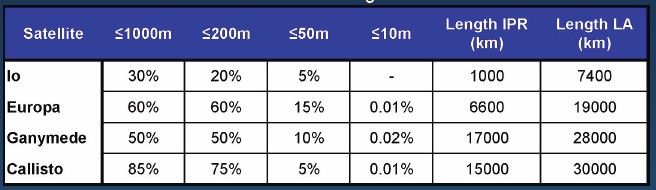
The kind of mission I've described would not replace dedicated orbiter for either Europa or Ganymede.  The option to continue study of the Galilean icy moons on a Discovery budget, however, might be compelling and could mean that we don't ignore these worlds in the coming decade.  The following charts from the Jupiter Europa Orbiter planning documents give an indication of the types of coverage that might be possible with a multi-flyby mission.  (The JEO mission is no longer feasible given its cost and NASA budgets.)  The JEO encounters with Europa were designed to pump the orbit around Jupiter down to enter orbit around Europa.  As a result, the encounters occur over the same equatorial real estate.  A mission designed to maximize science from flybys presumably would vary the encounter geometry with coverage more like what JEO would have done at Ganymede and Callisto.


Example of coverage from multiple flybys for four Io, six Europa, six Ganymede, and nine Callisto flybys from the planning for the Jupiter Europa Orbiter (JEO) mission.  The imager on a Discovery mission might be less capable than that planned for JEO and might image smaller portions of the moons at these resolutions.  All images from http://www.lpi.usra.edu/opag/feb2010/presentations/Senskev8.pdf


Example image resolutions for Europa from JEO flybys.


Example image resolution for Ganymede JEO flybys.

Editorial Thoughts: If a multi-flyby Europa Discovery mission were proposed, I worry about whether the science would be compelling enough to compete against missions proposed for other destinations.  A multi-flyby mission would advance our understanding of Europa, but might not answer the fundamental questions the science community has.  If not, then an eventual orbiter would still be needed.  The same arguments could be made about a multi-flyby Io mission or the proposed Journey to Enceladus and Titan Discovery mission.  In the case of Io, the radiation levels are so high that a follow on orbiter mission is all but inconceivable.  The question, then, is when to fly a multi-flyby mission.  In the case of JET, it's two instruments provide measurements that fill gaps in the Cassini mission's measurements and neither instrument requires global coverage to add significantly to our knowledge.  Even so, I worry about whether review teams will consider it compelling enough for a $6-700M mission (with launch costs).

One concern for a Europa multi-flyby mission would be acquiring coverage of both hemispheres.  To minimize radiation exposure, the mission likely would have its perijove, and hence maximum radiation exposure, at the orbit of Europa.  (If radiation was not an issue, the perijove could be inside the orbit of Europa and have encounters on both the inbound and outbound legs of its orbit to image Titan on both hemispheres.)  This makes it difficult to change the encounter geometry over a reasonable mission lifetime.  Gravity assists could be used to walk the perijove around, but that would entail additional costs for a mission operations staff and a longer flight.  (Editorial note: I was surprised at how expensive mission operations for the multiple gravity assists for an Enceladus orbiter would be -- it would be a substantial portion of the Principal Investigator's budget for a Discovery mission.)  Perhaps mission designers have a good solution to this problem.

If I can see issues with a possible mission, then a team of experienced scientists and mission planners will have seen them, too.  If an Europa Discovery mission has been proposed, it likely has clever solutions to these issues.

If ESA's Jupiter Ganymede Orbiter is selected for flight, then I hope it's mission would be enhanced to include a number of Europa flybys.  One mission designer I've talked to says that the additional cost likely would be low.  In this case, the mission is justified by the in-depth, global measurements at Ganymede.  Flybys of Callisto and Europa would make nice bonuses.

Monday, April 11, 2011

Rethinking Icy-ocean Moon Missions - Part 1

Several weeks before the release of the Decadal Survey’s report, a special meeting of the Outer Planet Analysis Group (OPAG) was scheduled for the week following the release.  It was the only one of the analysis groups (there are also ones for Venus, the moon, Mars, and small bodies) to schedule a special meeting.  It was a strong hint that the report was not going to have good news for the outer planets community. 

For several years, the exploration of the icy-ocean moons Ganymede, Europa, Titan, and Enceladus has been the highest priority of the outer planet research community.  The Survey attempted to enable a vibrant outer planets program with three flagship missions on the recommended list (Europa and Enceladus orbiters and a Uranus orbiter and probe mission) and Io and Saturn probe missions on the New Frontiers candidate list.  In plusher budget times, the outer planet program would have been a big winner.

In the new leaner budget times, if there was a category of missions that was loser in the collision between he Decadal Survey’s recommendations, and the new budget realities for NASA’s planetary program, it was the icy-ocean moon missions.  The flagship missions now appear unaffordable.  The Io and Saturn probe missions do not address the icy-ocean moons.  Now, further exploration of these moons rests on the European Space Agency’s (ESA’s) possible Ganymede orbiter that is in competition with two good astronomy/astrophysics missions for selection.

The OPAG report from the meeting following the Survey report may be a first step in asking NASA to look for new approaches to enabling the exploration of icy-ocean moons.  The official report strongly endorses the Decadal Survey recommendations.  (You can read the report at http://www.lpi.usra.edu/opag/mar2011/meetingReport.pdf).  The closest OPAG came to suggesting a re-examination was a request to pursue non-Flagship outer planet missions and to consider technology improvements that might enable Titan missions.

I listened to a good portion of the meeting, and there were several requests to see if it would be possible to add an icy-ocean mission to the list of New Frontiers candidate missions mid decade.  (Unlike the Discovery missions that can be proposed for any target, New Frontiers missions are selected from a candidate list.  Proposals for the ~$650M-$1B New Frontiers missions are so expensive to prepare that the list is kept short so that proposing teams can focus their resources.)  There is precedence for such a request to change the New Frontiers list.  The previous 2003 Decadal Survey recommended four candidate missions, and the list subsequently was expanded mid decade.  In addition, the new Survey report states that possible New Frontiers class missions to the icy-ocean moons were not prioritized (and Ganymede was dropped from the previous list) at least in part because of the priority given to a now unlikely Europa flagship mission. 

Any decision to re-examine the New Frontiers candidate list properly belongs several years in the future.   In my next post, however, I’ll start looking at tactics and missions that might enable continued exploration of these moons in the coming decade.

Sunday, October 3, 2010

A Europa Observer?

A reader posted a question on my blog entry, Update on NASA's Planetary Program.  I thought that the answer might interest a number of readers.

Al wrote,

You stated

"My take on the "highly restricted" and "tough choices" is that one of the two flagship class missions widely discussed -- the MAX-C Martian rover and the Jupiter Europa Orbiter -- may not be recommended. If so, I'd place my bet on a Martian rover being recommended..."

If true, could that open up the possibility of a scaled down lower cost Europa mission (Frontier class), perhaps limited to a short duration study of Europa itself and not the entire Jupiter system? Although I am a huge proponent of EJSM, I would still be thrilled to get a limited Europa focused mission, especially if it could arrive there before 2027 (ideally 2018 or so).

For convenience, I'll call this limited mission the Icy Moons Observer (IMO).  It appears that it is possible to fly a mission to the Jovian system for studies of the Galilean moons at Discovery mission (~$450 M) -- the Io Volcano Observer -- or New Frontiers (~$650 M) -- ESA's Jupiter Ganymede Orbiter -- costs.  Either of these concepts probably could be stretched to include a number of flybys of Europa in addition to other targets without busting the budget too badly.  (Note: The Io mission would have the wrong instruments to study an icy moon, but the spacecraft design could be refitted with appropriate instruments.)

One could imagine an IMO mission that has multiple encounters with all the icy Galilean moons.  A number of Europa flybys (a dozen? twenty?) could carry out global and regional surveys of that moon.  Then the spacecraft might enter Europan orbit for a lifetime of a month or two (compared to the nine months plus of the proposed Jupiter Europa Orbiter Flagship mission) to carry out detailed measurements of selected locations.

I don't know, however, if a Europa orbiter can fit into either a New Frontiers or even a small Flagship (~$1B) class mission.  A mission that enters Europa orbit will end with the spacecraft crashing on that moon's surface.  To ensure that Earth organisms don't contaminate Europa, stringent planetary protection design and assembly requirements would have to be taken.  This would step up the costs by some increment (that's unknown to me).  Also, staying in orbit even for a month or two would greatly increase the radiation dose the spacecraft would suffer compared to a mission that only had flybys.  This would result in another step function in mission costs.

So an IMO mission that focuses on flybys of Europa and possibly orbiting one of the further moons (probably Ganymede) certainly seems doable.  A mission that orbits Europa even for a short time may or may not be doable within a constrained budget. 

For those interested, a previous blog entry on a possible Galilean Moon Observer provides additional background on what might be possible.  The posts on EJSM flyby science and a concept for a solar powered Europa orbiter might also be interesting.

Sunday, May 23, 2010

Europa/Ganymede Penetrator

A conference on the  Europa Jupiter System Mission (EJSM) has just completed, and the presentations are a treasure trove of information on the proposed missions from three space agencies.  (The presentation from the fourth, the Russian space agency, has not been posted.)  The conference focused on the science questions and goals for these missions, and I recommend reading them (http://jakal.sp.ph.ic.ac.uk/EJSM/#Presentations)

This is the next to last post in a series that looks at the science of the EJSM missions (see Satellites, Jupiter, and Magnetosphere), with a focus on science other than that which would be done in orbit around Ganymede and Europa.  In this post, I’ll summarize the proposal for penetrators for Ganymede and Europa.  These are not the only lander concepts that are being investigated.  A conference was held last year to discuss lander missions that range from a very large Russian lander to small hard impact landers and penetrators.  I summarized these concepts in two blog posts (Russian Lander and Small Landers) or your can read the presentions at http://www.iki.rssi.ru/conf/2009elw/

At the more recent EJSM conference, presentations were given on the large Russian lander (not posted at the time I write this) and for a small penetrator that would be carried by the Jupiter Ganymede Orbiter and the Jupiter Europa Orbiter (see Europa Surface Element presentation).  The penetrator would weigh just 15 kg with 1 kg for science instruments.  The deorbit module for Ganymede would weigh 70 kg.  After achieving orbit around its target moon, the orbiter would release the penetrator, the deorbit module would perform the deorbit maneuver and orient the penetrator for impact.  Penetration into the surface would be a half to a full meter.  Polar landing locations would provide optimum data relay opportunities since the orbiter would pass over the poles each orbit but over each equatorial location just twice twice for every revolution of the moon around Jupiter. Surface lifetime for the penetrator would be just two orbits of the moon around Jupiter (~7 days for Europa and ~14 days for Ganymede).  [No explanation is given for why the Europa lander would not also operate for 14 days.  It seems unlikely to be due to radiation; the penetrator will have already been subjected to intense radiation while still attached to the orbiter.]


The scientific goals for the penetrator would focus on the internal structure of the moons, surface composition, and surface strength and mechanical characteristics.  The core payload would be a seismometer to study the internal structure of the moon, which would consume a third of the payload mass.  A number of other instruments could also be added.  One slide lists a possible instrument compliment that adds a mass spectrometer, accelerometer, thermal sensor, descent imager, and a magnetometer.  The slide notes that including the descent imager could pose problems for the other instruments sampling the surface.

Not discussed in this presentation is a possible enhancement that would essentially be a mini-probe carried within the penetrator that has received some publicity lately (see thermal drill article).  This would be a thermal drill that would melt and drill its way to depths as great as 10 m below the surface where the material should be free of chemical changes caused by radiation.  The unit would be a small, self contained package that would leave the body of the penetrator but remain connected by wires for power and communications.  A paper in Advances in Space Research is vague about what kinds of useful instruments could fit within the small body of the unit: “A melting system could sample waters which are transported into the instrument by the use of a micro-pump. A series of filters retains biogenic material, if present, for further analysis by an optical microscope, a chemical micro-laboratory or spectrometry.  Gases, as indicators of biological activity, could be acquired by this combination of heating and drilling... Current GCMSs are not suited to be integrated into the thermal drill itself (due to size), but could eventually be mounted inside the penetrator... A wet experiment was developed for the Deep-Space-2 penetrators and tested in impact trials.”

Editorial Thoughts: Penetrators would significantly enhance the science return from these missions, and I hope they will be flown.  As I understand it, neither ESA nor NASA are planning to pay for their development.  Their inclusion into the mission would require another national space agency to fund the development.  The presentation on penetrators was made by the Penetrator Consortium, a group of researchers located primarily in Britain.  (The site has several interesting presentations on penetrator concepts for various solar system targets.)

The presentation at the EJSM conference and those at the consortium website suggest that the primary focus for now is on a penetrator for Ganymede.  Analysis of for a Europa penetrator has several "to be determined" entries, with the key one probably being whether the penetrator's electronics could withstand the radiation dose as the orbiter maneuvers into Europa orbiter and then in Europa's orbit.  It's hard enough to design electronics that can withstand slamming into an icy surface.  Designing electronics that could also withstand the radiation may be too difficult.  However, the metal body of the penetrator would provide some shielding and perhaps additional shielding could be carried by the orbiter (think of the penetrator and deorbit module inside a box or tube mounted on the orbiter). 

Europa is a significantly smaller moon than Ganymede, and the deorbit module would be correspondingly smaller.  The JEO orbiter is reserving 100 kg of mass for a possible penetrator.  I wonder if the deorbit module might be enough smaller that JEO could carry two penetrators (assuming that the space can be found on the orbiter to house two penetrators).

And I am disappointed that there’s no mention of a surface camera.  I understand the problems of including a deployable mast in a small penetrator.  Still, it would be wonderful to see Jupiter in the sky above these moons.

Saturday, March 27, 2010

Europa vs. Titan Redux?

The presentations at the February OPAG meeting held statements that the Europa versus Titan decision may come back up for review. Last year, two teams competed to be selected for the next NASA Flagship mission and for a place in ESA's next large mission competition.  The review teams concluded that the science from either mission would be equally good, but that a decade of technology development made the Europa mission much more ready for development than the Titan mission.  A NASA Europa mission got the nod and an ESA Ganymede orbiter won a spot to compete against two astronomy missions (with the ESA decision to come next year).  Both space agencies promised to fund advanced mission planning and technology development to make the Titan mission ready for its own start later in the decade.  [Editorial note: The Survey could decide not to prioritize missions to either Europa or Titan, but I wouldn't take a bet on that outcome.]

Now, that decision on the American side is up for review as part of the Decadal Survey.  NASA has made it clear that it will take its priorities for planetary missions in the coming decade from the Survey's priorities.  Any mission that has not received a formal new start from Congress must be recommended by the Survey for NASA to procede.  That includes the Jupiter Europa orbiter.  


NASA's current budgets continue to fund the Jupiter-Europa for Phase A, which is the period of advanced development before final design, manufacture, and testing begin.  Funding beyond Phase A is contingent on the Decadal Survey making this mission a priority.  To do that, the Survey would have to deprioritize other elements in NASA's current roadmap.  At $3.2B, there simply isn't room in the budget for this mission and the current Mars program and the New Frontiers and Discovery programs (see here for analysis of latest NASA budget proposal).

At the same time, the proponents of Titan as the choice for outer planet exploration are working to be making their voices heard.  One of them, Ralph Lorenz, presented at the meeting.  He showed that Titan has been to subject of many more scientific articles than has Europa over time. (To be fair, the Cassini-Huygens mission has returned far more data on that moon than the crippled Galileo spacecraft did for Europa.)  He also complained that promised funding for advanced development of a future Titan mission has not been forthcoming.  As an example, he described how promised money to develop balloon technology for a Titan mission had gone instead to fund the Decadal Survey.

Cassini's continued exploration at Titan continues to build the case for returning to that world and to neighboring Enceladus.  The case also is being made that Titan could be home to exotic forms of life and one scientific paper has prioritized Titan ahead of Mars as the best place for astrobiological exploration in the solar system (Europa came in third).  Recent finds at Enceladus continue to build the case that that moon has an internal ocean that could host life.

Whether to return to Europa or Titan or both or neither in the coming decade looks to be one of the biggest decisions facing the Decadal Survey.


Editorial Thought
s: Europa-Jupiter and Titan-Enceladus-Saturn both are compelling targets for exploration.  Both destinations should be explored in the coming decade.  However, the radiation belts at Jupiter impose significant technical challenges to any mission that will meaningfully answer the question of whether Europa could be explored for life, either by finding a thin point in the ice to penetrate or by finding a location where recent eruptions have brought ocean material to the surface.  On the other hand, Titan-Enceladus-Saturn presents a relatively benign environment (if a bit chilly within the atmosphere of Titan), but the mission design and technology apparently aren't ready to fly for some of the most exciting mission concepts.

If the decision were up to me, I would commit to the $3.2B Europa-Jupiter mission and budget another $2B for Titan-Enceladus-Saturn, which might be expanded if other space agencies contributed.  I'd go ahead with the Jupiter Europa Orbiter as planned -- it's ready to go and the harsh environment at Europa doesn't favor cheap missions.  It would also do for the Jupiter system what Cassini is doing for the Saturn system and what Galileo with its crippled antenna couldn't.  Around $2B probably would fund a highly capable orbiter or a less capable orbiter (perhaps similar in scale to the proposed Io Volcano Observer)  and a Titan in-situ probe such as a lake lander.  


An alternative strategy would be to commit ~$3B to Titan-Enceladus-Saturn, perhaps for a combination of New Frontiers scale missions.  Perhaps a Saturn orbiter could execute a number of flybys of Titan and Enceladus with  instruments tuned to fill gaps in Cassini's investigations.  The orbiter could also act as a relay for one or two in situ Titan craft, perhaps the Titan Mare Explorer and the aerial AVIATR.  The Europa-Jupiter mission would then be constrained to a $2B mission.  Within that budget, a capable craft could perform a number of flybys of all the Galilean moons, study Jupiter from afar, and perhaps orbit Europe for weeks instead of the months planned for the Jupiter-Europa Orbiter.  However, the orbiter missions under investigation by the Decadal Survey do not currently include alternatives to the Flagship, ~ $3B, Europa Jupiter System Mission and the Titan Saturn System Mission for exploring those two moons.  The Survey is looking at a number of mission concepts to explore Enceladus, a Titan Lake lander, a Ganymede observer, and an Io observer.

Either of these plans could leave ~$5B for Mars exploration, which would fund the Mars Trace Gas orbiter and the 2018  ExoMars/Max-C mission and leave ~$2.5B for other Mars missions, presumably down payment on a sample return.  In this scheme, lunar, inner planet, and small body exploration would have to share the remaining ~$2B, which would fund perhaps a Discovery mission and a New Frontiers mission.

Baring breaking news on future planetary exploration, the next two blog entries will look at the planning for the science that the Jupiter Europa Orbiter could do for Jupiter and the Galilean moons other than Europa.

Resources:


Updates on NASA outer planets program and status of Jupiter Europa Orbiter funding from Feburary OPAG meeting
Ralph Lorenz's OPAG Presentation on status of Titan mission planning

Space News article on possibility of life on Titan http://www.space.com/scienceastronomy/titan-water-life-am-100323.html


Paper prioritizing Titan for astrobiology missions, The Search for Alien Life in Our Solar System: Strategies and Priorities


Tuesday, March 9, 2010

BBC Article on Jupiter Europa System Mission

The BBC has an in-depth interview with Dr. Robert Pappalardo from NASA's Jet Propulsion Laboratory.  Dr. Pappalardo has led JPL's efforts to define the Jupiter Europa Mission.  This interview provides a very nice perspective on the science goals of the proposed NASA and ESA missions to the Galilean moons.  I learned some interesting tidbits after following these proposed missions for a year and a half.  You can read the interview here: http://news.bbc.co.uk/2/hi/science/nature/8537992.stm

Sunday, January 10, 2010

A Solar Powered Europa Orbiter?


The most interesting poster for me at the AGU conference in December was one from the Boeing company that presented a proposal for a solar powered Europa orbiter (Outer Planet Science Missions enabled by Solar Power P43A-1428).  With the recent decision to prioritize the plutonium-powered Jupiter Europa Orbiter, why would one consider a solar powered mission?  The first issue is cost -- JEO is a battleship and future budgets may only buy destroyers.  The second issue is the supply of plutonium 238.  NASA currently does not have sufficient supplies of P-238 to fly JEO, and depends on Russia selling P-238 to make up the shortfall.  Unfortunately, the Russians recently announced that they would not honor the existing plutonium contracts (to get more money?).  Even if a new agreement is reached, the delay in delivery may push JEO even further into the future.

This is not the first time solar powered Jovian orbiters have been studied.  NASA's Juno orbiter will be solar powered.  ESA considered a solar powered Europa orbiter in its Laplace study, while the proposed Jupiter Ganymede Orbiter would be solar powered.  I had been under the belief that the radiation levels at Europa would degrade solar arrays too quickly to be of use for a Europa orbiter.  (Juno and JGO avoid the high intensity radiation belts.)  The gentleman from Boeing told me that they didn't believe this would be a problem.  (I'm still not 100% convinced on this point and would like to see the results of a study that directly addresses this problem, but this is a hopeful indicator.)

The goal of the Boeing study was to do a conceptual design a New Frontiers class mission to orbit Europa to show that a solar powered spacecraft derived from commerical satellites could be the basis for a Europa oribiter.  This was not an in depth analysis, particularly I suspect of the ability to survive in the intense radiation found near Europa.

Still, the idea is intriguing, so I thought I'd do a thought experiment to see if a New Frontiers class mission might be possible.  The Boeing study suggested some key compromises that would have to be made.  Using solar panels would be one tactic.  Another would be to design for just three months of life in Europa orbit, instead of JEO's 9 months, reducing the costs of radiation hardened parts and shielding.  In addition, the craft would carry just 50 kg of instruments, although the poster doesn't specify whether this would be the unshielded or shielded weights.  JEO's instrument compliment would be 106 kg unshielded and 165 kg shielded.  So, the science capabilities would be drastically reduced under this proposal.

For discussion purposes, we'll assume that a solar powered craft could fly ~50 kg of unshielded instrument weight and the additional weight of shielding.  The JEO science team listed a core, not worth flying without, list of instruments for an Europa orbiter.  That list appears below, too which I added the next highest instrument priority, a narrow angle camera.  This last instrument would be useful for spot high resolution imaging of Europa from orbit, but would be crucial for studying the other Galilean satellites and Jupiter prior to Europa orbit insertion.
   

Figures are unshielded instrument masses in kilograms.

Based on this thought experiment, an unshielded payload mass in the range of 50 kg is in the right ballpark.  Note, however, that the proposed JGO radar is much less capable than the proposed JEO radar.

So, is a New Frontiers class Europa orbiter really feasible?.  We are talking about going from a $2.7B (FY '09 dollars as I recall) to a $650M mission.  From the Io Volcano Observer studies, it appears that $450M (not including launch vehicle) buys you a Jupiter orbiter-satellite flyby mission in a relatively benign radiation enviroment (thanks to the high inclination orbit of IVO that minimizes time spent in the high radiation belts near Io).  JGO is estimated at $800M euros.  ESA includes launch vehicle but not instrument costs.  Figure instruments would cost $100M or so (see What Instruments Cost).  NASA includes instrument costs in its New Frontiers budget but not launch costs.  Add ~$250M for a launch vehicle, and the New Frontiers budget is ~$900M versus JGO's $800M euro.  (I'm ignoring currency exchange rates here, which are set by currency traders based on interest rates and supply and demand.  Based on my last trip to Europe, 1 euro purchased less in consumer goods than did $1 spent in the United States.  I neglected to buy any planetary spacecraft, so I'm not sure of the relative purchasing power for aerospace components)  However, JGO doesn't included radiation hardening that a Europa orbiter would need, so add $100M?, $200M? to the JGO price.

Long story short, I think that a solar powered (or ASRG powered) Jovian orbiter with multiple flybys of the three icy moons probably would fit in a New Frontiers budget.  A Europa orbiter seems a stretch, and probably a full mission cost with radiation hardening, instruments, and a launch vehicle would be in the neighborhood of $1 - 1.25B.  Still, this would be much cheaper than the JEO mission, at a cost of much less data returned.  If exploration budgets or plutonium supplies prove to be tight, this would seem a reasonable tradeoff to me.

One nice extension of this idea is that a solar powered Europa orbiter design could also be used as the basis for a Saturn orbiter, Titan and Enceladus flyby (and maybe even orbiter of one of those moons) spacecraft.  In fact, the real goal of the Boeing poster was to discuss solar power for both Jupiter and Saturn missions.  With current solar power technology, a Saturn mission might be on the edge.  However, the poster discussed new technologies using concentrators that would enable 1kW of power at Saturn.

Thursday, April 9, 2009

Russian Europa Lander

See http://futureplanets.blogspot.com/2009/04/russian-europa-lander-concept.html for the blog entry. Blogspot lists posts in the order written, not published, so this latest entry isn't at the top of the page.

Monday, April 6, 2009

Europa Hard Landers and Penetrators


This blog entry continues looking at presentations from the Russian-sponsored conference last January on Europa landers. The last entry looked at a proposal for a highly capable lander. This entry looks at proposals for two smaller landers.

Concepts for planetary landers fall into three classes. The first is for soft landers like the Mars Phoenix or MER rover craft. Combinations of parachutes, rockets, and or airbags soften the landing force. As a result, highly sophisticated craft and instruments can be delivered to the surface.

The other two classes of landers only partially spell the energy of descent and as a result do what can be termed as a controlled crash with style. Hard landers simply hit the surface, bounce and eventually come to a stop. Penetrators look like small rockets and burrow, nose first, into the ground and use the friction of ground penetration to stop some distance beneath the surface. Both classes of landers require hardened instruments and system electronics, which limit their capabilities. There isn't room for complicated masts to hoist imagers or robot arms to gather carefully identified samples for analysis. Instead, one or two simple instruments are carried. The landed mission lasts until the small batteries are exhausted.

The conference had presentations proposing both types of landers. The hard 'stop and drop' lander was discussed by a team from the Jet Propulsion Laboratory, one of NASA's centers. The team presented a number of possible instruments, but focused on an accelerometer (presumably to study the surface hardness but possibly also to measure some seismic activity), a gas-chromatograph/mass spectrometer, and a camera. The goal would be to conduct measurements for a full Europan day (84 hours) plus an additional 12 hours for additional data relay to the orbiter. Approximately 14 to 24 Mbits of data would be returned, depending on the altitude of the orbiter.

The penetrator presentations was done by the UK Penetrator Consortium. Here a small penetrator, perhaps 60 cm in length, would carry around 2 kg of instruments. Possible instruments include a seismometer, mass spectrometer, soil/environment package, simple surfve and descent cameras. Penetrators are used in a number of terrestrial studies, especially when dropped from airplanes. They have been studied for planetary missions for decades. Except for the doomed Deep Space 2 probes, none that I remember have flown. The Japanese space agency came close to flying penetrators to the moon, but canceled the mission due to development problems.


The hard lander presentation showed that for the nominal 2020 launch date and current mass estimates for the Jupiter Europa orbiter (JEO), 260 - 320 kg spare mass margin. (Note: spacecraft have a nasty tendency to grow in weight as design progresses and right now the JEO exists only as preliminary computer files.) No weight estimate is given for the hard lander plus descent system; presumably it would fit within the mass margin. One chart suggests a lander mass of 100 kg plus 35 - 65 kg of propellant. The penetrator presentation showed a mass of 30 kg or less for the penetrator and descent system. This would potentially allow several penetrators to be carried.

Editorial Thoughts: A number of problems exist with hard landers and penetrators. First, they require miniaturized desent craft that kill the orbital speed and possibly some of the descent speed. In the case of the penetrators, the descent craft also must ensure that the penetrator is pointing down for its impact. Another issue is the tight space in within the landers or penetrators -- every system must be miniaturized and hardened against impact, which reduces capabilities (including battery life). It is also hard to build miniaturized sample devices to bring material into the craft for analysis. This is especially true for hard landers which must be capable of acquiring samples no matter which side ends up being in contact with the surface. Europa would also poise a special problem for small surface landers -- there's not much mass to provide shielding against the radiation that will be present. Here, penetrators would have the advantage because the surrounding ice would provide some shielding.


Neither presentation gave more than passing mention to the radiation environment, suggesting -- as with the soft lander discussed in the last blog entry -- that these are preliminary concepts. I have my doubts about whether either would actually fly. On paper, the landers seem reasonable. As we learned from the Deep Space 2 and Beagle 2 landers, however, building and testing craft that would actually survive is hard and requires substantial financial resources.

However, should either concept make it to flight, I have a slight preference for the penetrator. I believe that it would be the lighter of the solutions, perhaps allowing 2 -3 to be carried. I suspect that crashing into the surface of Europa could be fatal a high percentage of the time. Redundancy would be nice.

If a lander is designed for Europa, then in theory it could be modified to also fly on ESA's Jupiter Ganymede Orbiter (JGO). The primary difference that I see would be the need for a heftier descent system to account for the greater mass of Ganymede.

Resources:

Hard lander presentation: http://arc.iki.rssi.ru/conf/2009elw/presentations/presentations_pdf/session2/Hand_ELW.pdf

Penetrator presentation: http://arc.iki.rssi.ru/conf/2009elw/presentations/presentations_pdf/session7/Gowen_ELW.pdf

Deep Space 2: http://en.wikipedia.org/wiki/Deep_Space_2

Beagle 2: http://en.wikipedia.org/wiki/Beagle_2

Sunday, April 5, 2009

Russian Europa Lander Concept


At the Russian sponsored Europa lander meeting last January, the Russian space agency presented a concept for a Europa orbiter. This presentation focused on the spacecraft hardware. Other presentations looked at possible scientific instruments.

The mission outlined is an ambitious one. The mission consists of a series of stacked stages and spacecraft. The first stage would be a solar electric propulsion unit that would help deliver the orbiter stack to Jupiter following a three years cruise. A propulsion stage brakes the stack into Jupiter orbit where gravity assists allow the eventual Europa orbit insertion in early 2024. The stack then separates into a Europa orbiter and a highly capable soft lander.


The science potential of the mission could be substantial. During the Jupiter system tour, the spacecraft would perform thirteen Ganymede and four Callisto flybys. The orbiter would carry 50 kg of scientific payload. That is sufficient for capable studies during the flybys and while in Europa orbit. The lander would host 70 kg of instruments. Both the orbiter and lander would be powered by RTG's, providing the mission with considerable operational flexibility.


Editorial Thoughts: The mission concept certainly is ambitious. Left unmentioned is the elephant in the room for any Europa mission -- the radiation environment. This seems a curious oversight. NASA has spent a decade developing technology that can withstand the radiation at Europa. Perhaps considerable work is underway to develop the technologies to solve this problem and simply wasn't included in the presentation. It appears that the time in Europa orbiter may be limited to a small number of months, which would help. Without this issue being addressed, however, I am left wondering whether or not this mission is merely a pipedream or a serious proposal. If anyone reading this blog attended the mission, your clarification would be very welcome.

Even without the issue of radiation, the mission is technically ambitious, especially for a first flight by the Russian space agency beyond the orbit of Mars. The presentation does point out that the Europa lander concept builds upon technologies that will be used in the Phobos sample return and the lunar lander missions. I don't doubt that the Russians are capable of developing the technologies needed -- they are the only nation to have landed on Venus. The Venus program, however, built up capabilities over time with missions becoming more sophisticated as technologies were developed and concepts proven. Going directly from Phobos and the lunar surface to Jupiter and the surface of Europa seems a large step.

I also think that the time frame for the mission seems wrong. It would seem more logical to me to have the lander arrive after NASA's Jupiter Europa orbiter has mapped the moon and identified both safe and scientifically interersting locations. This would delay arrival to 2029. The extra five years also could provide more time for the Russian space agency to hone the technologies for a Europa mission.

I hope that my skepticism is unfounded. A Europa lander would be an excellent addition to the 2020's exploration of the Jovian system.

Resources:

Europa lander concept presentation: http://arc.iki.rssi.ru/conf/2009elw/presentations/presentations_pdf/session2/martynov_ELW.pdf

Website with all presentations. Look towards the bottom for a number of presentations on potential instruments. http://arc.iki.rssi.ru/conf/2009elw/presentations/

Wednesday, February 18, 2009

Europa Jupiter Flagship Development Schedule

Jason Perry has a nice summary of the schedule for developing the just selected Europa Jupiter Flagship mission.

A couple of people have noticed that the voting on this blog for your choice of Flagship mission ended just a couple of hours after the selection was made. Voting was opened early last fall. One reader wondered if I had some inside track. Unfortunately, I just got lucky...