Tuesday, August 20, 2013

Small Could be Beautiful - Planetary SmallSats

The concept is new enough that there’s not even a consensus on what to call the spacecraft – SmallSats, micro-satellites, tiny spacecraft. 

Traditional spacecraft – let’s call them LargeSats – weigh hundreds of kilograms and cost hundreds of millions of dollars.  At the other end of the spectrum, CubeSats are based on the electronics that have enabled phones to be respectable computers, entertainment centers, and cameras.  The smallest form factor for CubeSats is just 10 × 10 × 10 centimeters, weighs approximately a kilogram, and can cost as little as $60,000 to build.  Large CubeSats expand the length to 60 centimeters and the mass to approximately 6 kg.

While over a hundred CubeSats have been placed in Earth orbit, their small size poses challenges for planetary missions.   A CubeSat that would travel to and orbit Mars, for example, must deal with the harsher radiation environment beyond Earth’s magnetosphere, carry a propulsion system to make course corrections and brake into Martian orbit, have a beefed up communications system to return data from up to 300M kilometers away, and provide solar panels large enough to collect sufficient sunlight at Mars’ greater distance from the sun.  There’s just not enough mass or space to do all that within the CubeSat form factor

CubeSats are likely to play a role in future planetary missions, but most frequently as daughter craft carried to their destination by larger spacecraft.  (I’ll explore possible concepts in a future post.)

An emerging class of spacecraft – I’ll call them SmallSats – would fit between LargeSats and CubeSats.  These spacecraft make use of the design techniques of CubeSats but scale the form factor up to a meter or so and the mass up to 50 to 100 kg or so.  At this size, the spacecraft could meet the challenges of interplanetary missions.

I’ll also note that the potential for SmallSats isn’t limited to planetary missions.  At least two commercial companies are planning spacecraft in this class for high resolution (3 to 5 m) imaging of the Earth.  If successful, they would compete with current companies such as WorldView that are currently using traditional LargeSat designs that cost and weigh an order of magnitude more than their planned SmallSat equivalents.  (See articles at The New York Times and Wired Magazine.)

At the Low Cost Planetary Mission conference last June, several concepts for SmallSat planetary spacecraft were presented.  I’ll use the concepts presented to explore the potential and limitations of this class of spacecraft for future planetary exploration.

Engineers from JPL presented their concept for one class of these spacecraft, the Micro Surveyor, for missions in the inner solar system.  While the first planetary SmallSat may cost around $40M, their goal is to create a design for spacecraft in the $20M range to enable  total mission costs to eventually be around $100M (compared to $450 to $500M for NASA’s Discovery missions and $750M to $1B for New Frontiers missions).


Conceptual design for JPL’s Micro Surveyor planetary spacecraft that would stand just 0.9 m high.  The design is sized to fit within the space allocated for secondary payloads adapter ring (ESPA) on the launch of larger spacecraft (insert figure in the upper right).  Propulsion would be provided by an electric propulsion system (EP).  Credit: JPL.

The design is sized to be carried as a small secondary payload on the launch of a larger spacecraft such as a communications satellite to enable low cost launches.  Once in Earth orbit, a Micro Surveyor would use an electric propulsion system (similar to, but much smaller than the ion engine being used by the Dawn spacecraft) to gradually change its orbit to flyby the Earth’s moon.  Encounters with the moon would provide gravity assists that would put the spacecraft on a trajectory to Venus, Mars, or an asteroid or comet near Earth.  (While not mentioned in the presentation, the moon itself could be a mission target.)

The flight times to Venus or Mars illustrate one of the limitations that this approach has.  While LargeSat missions to these planets can arrive in less than a year (thanks to a dedicated launch that puts the spacecraft on a direct trajectory), a Micro Surveyor spacecraft would take ~16 months to reach Venus and ~36 months to reach Mars.  Once the spacecraft reaches its target world, the electric propulsion system would allow a slow spiral into the science orbit.  Patience may be a virtue, but the longer flight times mean that mission operation costs will build up during the longer flights.

The small size of the spacecraft also would limit the scientific payload.  While a LargeSat Discovery mission might have 50 kilograms or more in instruments, the Micro Surveyor spacecraft is being designed to carry just 15 kg of instruments.  The mission planned for the Micro Surveyor would also need to fit within the limited power available to the instruments and the restricted bandwidth of data the tiny spacecraft could return to Earth.  A Micro Surveyor could, for example, carry a camera to Mars for high resolution imaging (3 to 5 m) of the surface, but the mission would be severely limited in how many images could be returned per day. 

Also, Venus, the moon, Mars, and near Earth asteroids have been (or are planned to be) visited by many spacecraft.  Much of the low hanging fruit in terms of science has been done.  With an estimated cost of ~$100M per Micro Surveyor missions, finding a new, compelling scientific missions that fit within the mass, power, and data limitations of the spacecraft may prove to be a challenge. 

At the conference, the JPL presenter did not suggest any specific mission concepts for the Micro Surveyor.  I’ll suggest three possible mission concepts that occurred to me that might meet the goals of conducting interesting new science while fitting into the mass, power, and data constraints.  I want to emphasize that this is amateur armchair mission architecture; none of these concepts may pass technical muster when examined by real mission architects.

The first concept would target Venus.  The clouds of Venus have made observation of the surface difficult by orbiting spacecraft.  While larger missions can carry heavy and power hungry radar systems to image the surface, mapping the surface composition has been largely impossible because the clouds block the view.  A series of spectral windows in the near-infrared (between 0.8 and 1.8 μm), however, allow observation of the surface.  The VIRTIS instrument on the Venus Express spacecraft has mapped portions of the planet using these windows to examine surface areas for different compositions and look for temperature differences suggesting volcanic activity. 


Red-orange colors in this VIRTIS image of Venus’ Idunn Mons volcanic peak indicate warmer areas suggesting different surface compositions and younger ages than surrounding material.  Press release describing the science available here and image caption here.  Credit: ESA.

The VIRTIS instrument, however, was designed for analyzing the cloud deck, and has low resolution (~150 kilometers) and isn’t optimized for observations at the wavelengths of the spectral windows.  A follow on instrument optimized for surface mapping (along with further cloud studies) has been proposed for future European Venus missions.  The proposed Venus emissivity mapper would weigh just five kilograms, easily fitting within the mass constraints of a Micro Surveyor mission.  (In fact, on a dedicated mission, a more capable instrument might be flown than has been proposed.)  Fitting within the data constraints of a SmallSat mission, though, might require creative mixing of low resolution global mapping with targeted higher resolution mapping for priority targets.

A second  concept would explore the diversity of comets.  Visits of several comets by spacecraft have shown that these relics from the formation of the solar system are widely varied.  The spacecraft that made the observations to date carried different sets of instruments, making systematic comparisons difficult.  One NASA Discovery mission, CONTOUR, planned to address this problem by visiting two or more comets with the same spacecraft and instrument suite.  Unfortunately, the CONTOUR mission failed early in its mission while leaving Earth orbit. 

The CONTOUR spacecraft carried a diverse suite of instruments: a remote imager/spectrograph (12.0 kg), an aft imager for post encounter images (1.8 kg), a mass spectrometer (9.3 kg), and a dust analyzer (11 kg).  Based on these masses, a Micro Surveyor comet mission could carry any one of the three larger instruments plus the equivalent of the aft imager.  (Because more than a decade has passed since CONTOUR’s launch, new versions of these instruments could be developed that would have less mass.  However, the small budgets foreseen for SmallSats probably would allow for only minimal tweaking of current instrument designs.  The soon-to-be-launched lunar LADEE mass spectrometer derived from the CONTOUR instrument, for example, is 11.3 kg.  Budgeting something around 10 kg for a SmallSat-scale mission mass spectrometer seems reasonable.)  The limited payload available for a SmallSat means that their science goals must be tightly focused.

A tweak on the comet mission concept would be to send a spacecraft to pass by one of the main belt asteroids that have been observed to emit gasses like comets, suggesting that they are either captured comets or very volatile rich asteroids (at which point, there may not be much of a difference).

At the same conference, researchers presented a concept for an outer solar system SmallSat mission.  This work was done to investigate the power requirements for such a mission to determine whether a small version of a radioisotope power system could meet the electric power requirements.  To gauge the spacecraft and power system, the team investigated a flyby of one or more Centaur objects, which have orbits within those of the outer planets.  The study team selected just two instruments, a narrow angle camera (2.4 kg) a hyperspectral infrared spectrometer (4 kg).  As a baseline, the study team looked at two SmallSat-scale spacecraft encountering the asteroid 2060 Chiron and a second pair encountering a second asteroid.  To reach the outer solar system, the mission would have a dedicated launch that would send the four craft two Jupiter where gravity assists would redirect the spacecraft to their final destinations.


Conceptual design for an outer solar system SmallSat spacecraft that would be 1.76 m high.  Multiple copies of this design could be launched together (insert) to provide redundancy or allow targeting of multiple destinations.  Credit: NASA, JPL.

The Centaur mission again shows the limitations of small payload masses.  Chiron has active gas emissions.  Being able to include a mass spectrometer to measure the composition of those gasses could greatly enrich our understanding of the formation of the outer solar system.  This is especially true if Centaurs were once Kuiper-Belt worlds that were later captured within the outer solar system. 
(If I can play armchair mission architect for a bit longer, the instrument masses for the Centaur concept are low enough that they could be paired with a mass spectrometer and almost fit within the payload of a Micro Surveyor.  A camera, imaging spectrometer, and a mass spectrometer would be a very nice payload for a comet, outgassing asteroid, or Centaur mission.)

While the presentation discussed only the Centaur mission concept, similar flyby missions could be done to any outer solar system body.   (A favorite of mine would be a flyby of Neptune’s moon, Triton.) 

The Centaur mission presentation brought up interesting questions on how to think about these missions.  Traditional planetary missions have sized a single spacecraft to carry all the instruments necessary to meet the science goals.  SmallSat-scale spacecraft are cheap enough each ($10M to$20M was mentioned at the conference) that perhaps you fly two or more to a single target.  For a comet or Centaur mission, perhaps one craft carries a camera and imaging spectrometer and a second carries a mass spectrometer.

Traditional planetary spacecraft have also carried dual copies of most critical systems so that if one fails, the spacecraft can continue operating on the second.  To keep mass and per spacecraft costs low, the concepts presented at the conference envisioned a single copy of each system.  Would risk management be better preserved by duplicating key systems within a single spacecraft or by flying two copies of the spacecraft?  For the Centaur mission concept, the mission architects suggest that two craft could be targeted to the high priority Chiron object and the other two craft could be targeted to separate objects.  If all craft succeed, three objects are visited.  If half fail, you would likely get Chiron and/or flybys of two different Centaur objects.

The Centaur mission presentation had one slide that suggests that building planetary spacecraft on tiny budgets only addresses part of the costs of a planetary mission.  The team estimated that the total mission cost would be $511M, only 20% of which would be for four copies of the spacecraft hardware.  (The design exercise was trying to hit the mission costs for a Discovery-class mission (~$500M in the future), rather than hitting a lower cost target.)  The rest of the costs were for design, testing, launch, mission operations, and budget reserves.  At the conference, presenters suggested that total mission costs for an inner solar system SmallSat-scale mission might be approximately $100M using a standard spacecraft designs such as the Micro Surveyor.  If that target can be hit, the cost of the spacecraft hardware would represent 20% to 40% of the mission costs.

At the moment, engineers and scientists are beginning to explore what might be accomplished by SmallSat-scale missions using today’s technology.  As technology progresses, the potential for these spacecraft will grow.  Another JPL team presented a concept for a near-Earth object hunter-seeker mission.  This mission would use a next generation micro-electro-fluidic-spray propulsion technology.  The spacecraft would first maneuver itself into an orbit just inside Earth’s orbit to begin a search for asteroids as small as a few meters across.  As interesting objects are found, the spacecraft would rendezvous with five to six of them for close up examination by a camera and imaging spectrometer and with surface contact to probe the asteroids structural cohesion.  Total mass for the spacecraft with fuel is estimated to be just 50 kilograms within a body (not counting solar panels) just 60 centimeters on a side. 
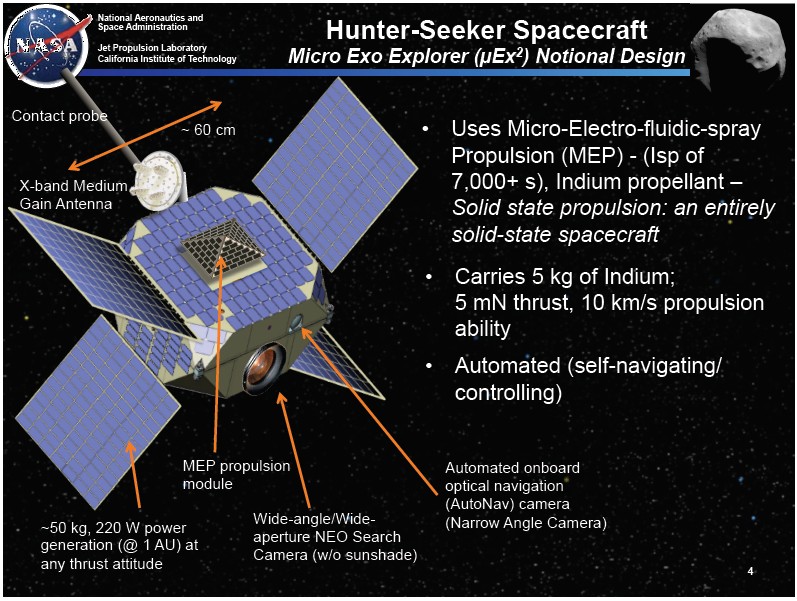


Conceptual design for a next generation SmallSat spacecraft for the near-Earth asteroid Hunter-Seeker mission.  Credit: JPL.

Editorial Thoughts:  SmallSats for planetary exploration are an exciting concept, especially when NASA’s planetary program faces tight budgets for new missions.  As I’ve tried to emphasize, though, they would complement, not replace larger missions.  The goals for many planetary missions need multiple instruments that each would approach or break the limits for a SmallSat.  The Mars MAVEN Discovery mission, for example, requires the simultaneous operation of a suite of instruments that together have a mass several times what a Micro Surveyer spacecraft could carry to understand the composition and processes in the upper atmosphere.  The HiRise camera on board the Mars Reconnaissance Orbiter has a mass of 64 kg, approaching the mass for an entire Micro Surveyor spacecraft (~75 kg).

However, SmallSats are promising to carry out highly focused investigations with smaller instruments or to visit objects that wouldn’t make the cut for $500M to $1B missions. 

Planeatary SmallSat missions could also provide opportunities for a new generation of scientists and engineers to take lead positions on smaller missions and gain the experience necessary to manager larger projects.  Currently, the pool of scientists and engineers with flight mission experience who can take lead positions for future Discovery and New Frontiers missions is shrinking as flight opportunities have dwindled.

For approximately half the cost of a Discovery mission with launch, NASA could fly two to three SmallSat-class missions.  I hope that NASA pursues the opportunity.  I expect that the planetary science community would show considerable creativity in finding ways to use missions in this class.

Resources:

The following links are to the presentations from the Low Cost Planetary Science 10 conference that discussed planetary SmallSat designs


Thursday, July 25, 2013

Mars Rover 2020: Astrobiology and Caching

NASA’s planned Mars 2020 rover likely will both continue the astrobiological exploration of Mars begun by the Curiosity rover and provide stepping stones to the next stages of Martian exploration. 

Two weeks ago, NASA’s Mars 2020 rover Science Definition Team (SDT) delivered its report recommending the science goals for the mission.  Probably to the surprise of no one, the team recommended essentially the same science goals as had several previous SDT’s on what NASA’s next mission to Mars should do.  Like the Curiosity rover currently on Mars and the planned European and Russian ExoMars rover mission, the 2020 rover will look for clues as to whether Mars ever contained the conditions to enable life and whether traces of life or pre-biotic chemistry remain.

The mission will also provide an important transition to the next phases of Mars exploration by caching samples that could eventually be returned to Earth and testing technologies for future human and robotic missions.

The challenge the SDT faced was how to do all of this on a budget (~$1.5B) that with inflation may be just somewhat more than the half cost of the initial Curiosity rover.  To fit within the budget, a key tradeoff would have to be made that will make the 2020 rover less capable in a key respect than the Curiosity and ExoMars rovers.

The 2020 rover will be enabled by the substantial investment NASA made in the design of the Curiosity rover and its entry, descent, and landing system.  NASA and the Jet Propulsion Laboratory that built the Curiosity rover also retain substantial stockpiles of spare parts and engineering expertise that can be used in rebuilding substantial portions of the spacecraft. 

I’ve read many press summaries of the SDT’s recommendations, which tend to focus on the proposed caching of samples for possible return to Earth.  If NASA follows through, this will be the first concrete step towards a goal that Mars scientists have made their top priority for decades.  However, the caching is just one aspect of the proposed mission.


Summary of the goals for the 2020 rover mission as envisioned by the SDT.  This and all images in this post are from the briefing to the Mars Exploration Program Analysis Group (MEPAG) July 23, 2013 presentation by the SDT chair, Jack Mustard (Brown University).  Credit: JPL

Double click on any image for a larger view.

To understand the full promise of this mission, I’ll go through each of the SDT’s proposed goals for the mission (which closely parallel those NASA asked the SDT to consider).  First, though, the proposed mission implementation to meet those goals makes more sense with some background on how rovers are used as scientific platforms.

In the course of driving several kilometers, a rover will pass by thousands of potential spots for more detailed examination.  Each of those examinations, though, can take days to weeks complete.  There is a tradeoff between driving distance, and hence number of locales that can be explored and the number of spots where in-depth data can be gathered.

To make the best trade possible between these two goals, the mission team employs a hierarchy of scientific assessments with those at the top taking the least time and those at the bottom the most.  First, the team uses orbital observations to select the locales it would like to visit.  Then as the rover arrives at each locale (and also during the drives between them), the rover’s remote sensing instruments are used to get the “big picture.”  From these images, the science selects a small number of targets for the next level of investigation by the contact instruments.  As the name implies, these instruments are placed in contact with a rock or soil sample target.  Instruments in this class include the microscopic imagers and alpha-particle X-ray spectrometers carried by the MER Spirit and Opportunity rovers and the Curiosity rover.  For a still smaller number of extremely interesting targets, the time is taken to collect a sample.  On the Curiosity rover and the planned 2018 ExoMars rover, these samples are delivered to highly sophisticated analytical instruments inside the rovers for more detailed measurements.  The 2020 rover will collect the samples and place them in a cache, which may eventually be returned to Earth for more detailed measurements than can be made within a rover.  (The MER rovers do not have the capability to collect samples.)


Rovers on Mars follow a hierarchical strategy for selecting a small number of targets for in-depth exploration.

The SDT described their proposal for the 2020 mission in terms of fulfilling four goals, and I’ll present their recommendations for each of those four goals.

Goal A: “Explore an astrobiologically relevant ancient environment on Mars to decipher its geological processes and history, including the assessment of past habitability.”


The 2020 rover would follow a hierarchical strategy to explore a location on Mars believed to have been habitable.  The definitive identification of past signs of life is likely to require the testing of returned samples in Earth laboratories.

Every NASA landed Mars mission – except the 1996 Pathfinder mission that focused on technology demonstration – has had the goal of exploring Mars’ past and current potential for life or pre-biotic chemistry.  For the MER rovers, the goal was simply to determine whether water – an essential ingredient for life – was present at the surface early in Mars’ history.  The Curiosity rover is exploring Gale Crater to examine soils from many eras of Martian history to determine whether or not environments for life existed and to determine whether biosignatures of past life remain.  The 2018 ExoMars rover will explore another site on Mars for its astrobiology potential.

The SDT has proposed that the 2020 rover continue the strategy and pursue astrobiology as the mission’s defining goal.  Its proposed strategy breaks into two parts.  The first is to have the rover carry a suite of instruments capable of a exploring site’s geologic history in-depth with an emphasis on how that history affected the possible presence of past life.

The team proposes that the rover carry multispectral cameras for obtaining images and an imaging spectrometer for analyzing composition across entire sites.  These instruments would provide the context to interpreting each locale’s history as well as allowing the science team to select specific targets for more detailed exploration.

For most of the contact science, the SDT is proposing that the rover carry a new generation of instruments.  Current Mars rover contact spectrometers measure mean composition over an approximately two centimeter contact area.  The new generation of instruments under development can make composition measurements for spots as small as a tenth of a millimeter.  With that resolution, the contact spectrometers would make dozens to hundreds of measurements across the contact area.

If you take a close look at soils and most rocks, you’ll see that most are composites of many fragments that each have their own geological story to tell.  The contact spectrometers that are likely to be proposed for the 2020 rover will be capable of exploring each of those fragments individually.  (The SDT also proposes that the rover carry an imaging microscope to study the morphology and texture of each contact area.)

The remote sensing and contact instruments listed above are included in the baseline recommendations and are expected to be affordable at the low end of the expected budget (~$90M to $125M) for the science instruments.  If the budget becomes plusher, the SDT recommends two additional instruments to study the shallow subsurface beneath the rover.  A ground penetrating radar would detect subsurface rock and soil layers, providing better context for understanding the geology exposed at the surface.  A gamma ray spectrometer would measure the composition of soil in the upper few centimeters and could alert scientists to interesting substances just below the upper veneer of soil.

A capable instrument suite enables scientific exploration; the rover still must be delivered to a location that orbital instruments show might have been a location for life or pre-biotic chemistry.  A number of such locations are known, and more are being searched for.  However, these sites often lie within rough terrains with just a small area free of large rocks that would end the mission should the rover be unlucky enough to land on one.  The 2020 rover mission will inherit the precision landing system developed for the Curiosity rover that reduced the area of the landing ellipse to a fraction of what it had been for previous landers.  

The SDT recommends shrinking that ellipse further to allow more landing sites to be considered.  On past missions, the parachute has opened at the earliest possible time during the descent.  For the 2020 descent, the SDT recommends that the entry system have the ability to vary the time of opening based on its estimate of its position relative to the landing zone. This relatively simple enhancement could reduce the size of the landing ellipse by 25% to 50%.

Many potentially interesting astrobiology sites on Mars lack any area the size of a landing ellipse free of large rocks or dangerously steep slopes.  A second enhancement the SDT asked NASA to consider is terrain recognition navigation (TRN) that would enable the lander to compare images of the landing area stored on board with real-time images taken during the descent.  This capability would allow the descent system to determine its actual location and steer free of hazardous terrain in the moments of final descent. 

Goal B: “Assess the biosignature preservation potential within the selected geological environment and search for potential biosignatures.”


Examples of potential biosignatures and measurements the 2020 rover could make to find them.

Much of the scientific attraction of Mars comes from its preservation of ancient surfaces and rocks that might retain records of conditions that could have led to life or even records past life itself.  The second proposed goal for the 2020 mission would have the rover actively assess whether biosignatures could have been preserved and to search for those biosignatures.

What would be a biosignature?  If we were extremely lucky, it might be fossilized layers from algae-like micro-organisms visible to the cameras.  More likely, it would be the alteration of rock or soil chemistry in a way that would be best explained by complex organic chemistry or the actions of life.  Again, if we were lucky, it could be the presence of organic matter preserved for billions of years.

The rover would seek biosignatures using all of the instruments listed above and with one or two instruments that would be selected for their ability to detect organic material.  The Viking and Phoenix landers and the Curiosity rover (and the future ExoMars rover) have relied on sophisticated analytical instruments such as mass spectrometers to detect organic molecules.  These instruments are capable of much more sophisticated measurements than is possible with contact instruments that must operate directly in the harsh Martian environment.  Analytical instruments have soil samples delivered to them where they can be analyzed with numerous techniques and altered through heating or wetting to release gasses or induce chemical reactions.

Unfortunately, the budget for the 2020 rover does not include funding for analytical instruments.  Instead, the SDT proposes that the rover carry one or two spectrometers capable of detecting the presence organic matter.  The authors of the SDT report are clear that the strategy they propose will result in the 2020 rover having significantly less capabilities to analyze potential organic material than other missions with analytical instruments.

The SDT points out a compensating new capability for the 2020 rover: sample caching.  As described below, if the cache is eventually returned to Earth, terrestrial laboratories could perform far more sophisticated measurements than would ever be possible on a rover or lander.

Goal C: “Demonstrate significant technical progress towards the future return of scientifically selected, well-documented samples to Earth.”


Priorities for samples to be collected.  The E2E-iSAG was a previous mission assessment for a rover mission focused on selecting and caching samples.

Returning a carefully selected set of Martian samples has long been a goal of the Mars science community.  The last planetary Decadal Survey ranked a mission to select and cache a set of samples for future return to Earth as its highest priority large mission for the coming decade.  A follow on mission would collect the samples and take them into Martian orbit, and a third mission would retrieve the samples from that orbit and bring them back to Earth.

The President’s Office of Management and Budget balked at beginning a sequence of missions that in combination could cost $6B to $8B.  They agreed to the 2020 rover mission to continue the in situ exploration of Mars and to demonstrate technical progress towards future robotic and manned missions, including caching samples.

The SDT concluded that the difference between demonstrating the technical capability to select and cache samples and actually leaving a returnable cache would be minimal.  They recommend the rover assemble a sample cache of up to 31 to 38 five centimeter long core samples of rock and soil acquired by the rovers drill.  Once collected, the cache would be placed on the surface for a future mission to collect in a few years or even a few decades.

Goal D: “Provide an opportunity for contributed Human Exploration & Operations Mission Directorate (HEOMD) or Space Technology Program (STP) participation, compatible with the science payload and within the mission’s payload capacity.”

When the 2020 rover mission was approved by the President’s office, one of the requirements was that it demonstrates technologies that would be useful for future robotic and human missions.  The SDT recommended four options be considered (in priority order):


  • Demonstrate the ability to capture and compress Martian air (which is primarily CO2) and extract liquefied oxygen for use as the oxidizer for the fuel for future a robotic or manned ascent stage from the Martian surface (commonly called in-situ resource utilization or ISRL).  While many parts of this technology can be demonstrated on Earth, key issues of collecting CO2 under varying dust conditions, winds, atmospheric pressure, and temperatures can be best demonstrated on Mars
  • Better instrument the entry and descent system to collect information on the conditions of descent and parachute performance.  (The Curiosity entry and descent system collected extensive information during its landing; the proposed 2020 system would collect that information and new information.)   The technologies discussed earlier to reduce the risk of landing by timing the parachute opening and using terrain recognition would also benefit future missions. 
  • Collect extensive weather information including atmospheric temperature profiles and atmospheric dust profiles to better understand atmospheric behavior.  Collecting this information would better characterize the atmosphere and reduce risk for future landings on Mars.
  • A biomarker system to “demonstrate detection of microbial contamination for future human missions.”

Concluding Thoughts


Capabilities of the 2020 rover proposed by the SDT.  Boxes without ‘+’ represent the recommended threshold capabilities below which the mission might not deliver sufficient value for the investment.  Boxes with ‘+’ represent highest priority additions beyond the threshold capabilities.  If more funding than the SDT were available, the mission could be further enhanced with either more capable instruments or additional instruments such as a weather station or additional instruments to characterize any organic matter.

The mission proposed by the SDT would meet the goals set out for a caching rover as the top priority in the last Decadal Survey.  It would also meet the goals recently set out by NASA for demonstrating key technologies for future missions.

At the same time, even if the samples not collected, the rover would carry out intensive geological and astrobiological exploration at a fifth site on Mars.  (The Viking landers explored two sites in the 1970s, the Phoenix lander explored the ice-rich northern plains, the Curiosity rover is exploring Gale Crater now, and the ExoMars rover will presumably explore yet another site.)  The new generation of contact instruments that will be ready for the 2020 rover will allow exploration of the composition of Martian soils and rocks at micro-scales that previous missions have not be able to do.  This is an exciting new capability.

While the SDT report doesn’t spend much time on the possible weather station that the 2020 rover may carry, I think this would be an important addition.  Scientists have long wanted to get a network of metrological stations on Mars to better explore weather patterns.  In 2020, there may still be three functioning weather stations already on Mars: Curiosity, NASA’s InSight lander, and the Russian surface station planned for the ExoMars mission.  A fourth station would be an important addition.

The 2020 rover is a mission that will be done on a tight budget.  The highly capable analytical laboratories of the Viking and Phoenix landers and the Curiosity and ExoMars rovers would not fly on the 2020 rover.  The capabilities the SDT recommends for the 2020 rover meet all the requirements previous SDT’s have laid out for a rover mission focused on sample selection and caching.  However, the 2020 rover would have less capability for science on Mars for characterizing organic matter and other volatiles than Curiosity or the ExoMars rover.

Of course, the need for the analytical laboratory would go away if the sample cache is returned to Earth laboratories.  The 2020 rover would make the investment in the first crucial step, selection and caching of samples, of the Holy Grail of Mars science: returning samples.  How long might those samples sit on the surface of Mars before being collected?  I expect that that will be a question for how compelling the discoveries by the rover’s instruments are and the generosity of future governments.  And it may not be American craft or only American craft that collect and return the samples.  In the coming two decades, several space agencies are likely to have the technology to participate in the sample return.

A second bet being made is to leave out a deep drill such as the ExoMars rover will carry.  The drill proposed for the 2020 rover will collect samples five centimeters (about two inches) in length, similar to that carried by the Curiosity rover.  This may not be deep enough to get below the surface radiation that is believed to destroy organic matter at Mars (see this post).  The ExoMars drill was designed with this problem in mind and will reach up to two meters below the surface.  Adding a similar drill to the 2020 rover would require a substantial modification to the Curiosity rover design isn’t possible within the budget.  However, if the Curiosity rover doesn’t find organic matter and the ExoMars rover does but deeper beneath the surface, then the bet on the shorter drill will look problematic.

Even with the current budget realities, though, the SDT has proposed a highly capable, exciting mission.  NASA’s officials warmly received the recommendations, indicating that their final choices for the mission are likely to be similar to those recommended by the SDT, but some changes are possible. 

A key decision by NASA will be on whether to fund the sample collection and caching system and the sophistication of that system.  Current news reports indicate that it intends to fly this system.

The next step for the mission will be for NASA to issue a call to solicit instrument proposals this coming fall.  The type of instruments NASA says it is interested in receiving proposals for is likely to be the definitive statement on the mission’s scientific goals.

For more information on the SDT’s recommendations you can read these documents.


Sunday, July 14, 2013

NASA Budget Update – Party Like It’s 1986

Long time readers of this blog know that in the past, I frequently wrote to give updates on the progress of NASA’s budget as it moved through Congress to final approval.  Before this year, no one else was providing this kind of coverage focused on the planetary program.  Now Casey Drier at the Planetary Society regularly posts updates, and I recommend that you add the Society’s blogs to your regular reading.  This will free up more time for me to write longer stories about potential and planned missions such as the one I did recently on Uranus.  (When I started this blog, I was getting my PhD, and had one dissertation-quality research project.  Now I’m doing three to four.)  I will still write in-depth analyses of NASA’s budget (and other space agencies when I can find detailed information), but will wait for major milestones.

This year, as you’ll recall, the President proposed to continue a much reduced (~$1.2B) budget for planetary exploration in Fiscal Year 2014 compared to budgets of ~$1.5B just a few years before.  The good news is that budget committees in both the House of Representatives and the Senate appear to want to substantially raise the FY14 budget compared to the proposal.  The House has recommended raising the budget back to approximately $1.5B.  It does so, in large part by substantially cutting the budget for NASA’s Earth Science program.  The cuts to the Earth Science program would be, in my opinion, as devastating for that program as the cuts to the planetary program have been at a time when human activities are dramatically changing our planet.  I believe those cuts would be ill-advised.  (Full disclosure: Part of my research funding has come from NASA’s Earth Science program and I use data from that program in my research.)

The proposed House budget would also reduce NASA’s overall budget to $16.6B, a figure that was last seen in 1986.  (Casey has a nice graphic in his post.)  If you go to one of the inflation calculators available on the web, you’ll find out that there’s been 112% inflation since 1986.  A simple consumer inflation index, however, doesn’t fully capture the change in costs for NASA.  The march of technology will have reduced the costs of many items and activities since 1986, but other costs such as maintaining buildings and making payroll probably will have increased close at a rate close to the consumer price index.  Regardless of how this proposed budget compares to 1986, it would be another in a series of cuts to NASA over the last several years.


This year the two houses of Congress (each controlled by a different political party) seem further apart than ever in their views of what the Federal budget should be.  I expect many twists and turns, which you can follow on Casey’s blog.  When major events occur, I will do my traditional in-depth analyses.

Tuesday, July 9, 2013

Mars Rover 2020 Has Its Goals Defined

NASA today announced the goals for its planned Mars 2020 rover mission.  The mission will be based on the Curiosity rover and its entry, descent, and landing design.

The science team laid out the following goals:


  • Explore an astrobiologically relevant ancient environment on Mars to decipher its geological processes and history, including the assessment of past habitability.
  • Assess the biosignature preservation potential within the selected geological environment and search for potential biosignatures.
  • Cache samples for a potential future sample return mission
  • Support technology demonstrations and weather measurements that will contribute towards a possible future human mission.

I'll read through the Science Definition Team's report this week and provide a more detailed analysis later this week.

In the meantime, Casey Drier at the Planetary Society Live Blogged the press conference.  I've also copied the press release below:

News release: 2013-217                                                                   July 9, 2013 

Science Team Outlines Goals for NASA's 2020 Mars Rover 

Science Team Outlines Goals for NASA's 2020 Mars Rover

The full version of this story with accompanying images is at: 
http://www.jpl.nasa.gov/news/news.php?release=2013-217&cid=release_2013-217 

WASHINGTON -- The rover NASA will send to Mars in 2020 should look for signs of past life, collect samples for possible future return to Earth, and demonstrate technology for future human exploration of the Red Planet, according to a report provided to the agency. 

The 154-page document was prepared by the Mars 2020 Science Definition Team, which NASA appointed in January to outline scientific objectives for the mission. The team, composed of 19 scientists and engineers from universities and research organizations, proposed a mission concept that could accomplish several high-priority planetary science goals and be a major step in meeting President Obama's challenge to send humans to Mars in the 2030s. 

"Crafting the science and exploration goals is a crucial milestone in preparing for our next major Mars mission," said John Grunsfeld, NASA's associate administrator for science in Washington. "The objectives determined by NASA with the input from this team will become the basis later this year for soliciting proposals to provide instruments to be part of the science payload on this exciting step in Mars exploration." 

NASA will conduct an open competition for the payload and science instruments. They will be placed on a rover similar to Curiosity, which landed on Mars almost a year ago. Using Curiosity's design will help minimize mission costs and risks and deliver a rover that can accomplish the mission objectives. 

The 2020 mission proposed by the Science Definition Team would build upon the accomplishments of Curiosity and other Mars missions. The Spirit and Opportunity rovers, along with several orbiters, found evidence Mars has a watery history. Curiosity recently confirmed that past environmental conditions on Mars could have supported living microbes. According to the Science Definition Team, looking for signs of past life is the next logical step. 

The team's report details how the rover would use its instruments for visual, mineralogical and chemical analysis down to microscopic scale to understand the environment around its landing site and identify biosignatures, or features in the rocks and soil that could have been formed biologically. 

"The Mars 2020 mission concept does not presume that life ever existed on Mars," said Jack Mustard, chairman of the Science Definition Team and a professor at the Geological Sciences at Brown University in Providence, R.I. "However, given the recent Curiosity findings, past Martian life seems possible, and we should begin the difficult endeavor of seeking the signs of life. No matter what we learn, we would make significant progress in understanding the circumstances of early life existing on Earth and the possibilities of extraterrestrial life." 

The measurements needed to explore a site on Mars to interpret ancient habitability and the potential for preserved biosignatures are identical to those needed to select and cache samples for future return to Earth. The Science Definition Team is proposing the rover collect and package as many as 31 samples of rock cores and soil for a later mission to bring back for more definitive analysis in laboratories on Earth. The science conducted by the rover's instruments would expand our knowledge of Mars and provide the context needed to make wise decisions about whether to return the samples to Earth. 

"The Mars 2020 mission will provide a unique capability to address the major questions of habitability and life in the solar system," said Jim Green, director of NASA's Planetary Science Division in Washington. "This mission represents a major step towards creating high-value sampling and interrogation methods, as part of a broader strategy for sample returns by planetary missions." 

Samples collected and analyzed by the rover will help inform future human exploration missions to Mars. The rover could make measurements and technology demonstrations to help designers of a human expedition understand any hazards posed by Martian dust and demonstrate how to collect carbon dioxide, which could be a resource for making oxygen and rocket fuel. Improved precision landing technology that enhances the scientific value of robotic missions also will be critical for eventual human exploration on the surface. 

NASA's Jet Propulsion Laboratory, a division of the California Institute of Technology, Pasadena, manages NASA's Mars Exploration Program for the NASA Science Mission Directorate, Washington. 

The complete Science Definition Team report is available online at: http://mars.jpl.nasa.gov/m2020/ . 

For more information about NASA's Mars programs, visit: http://www.nasa.gov/mars . 

Dwayne Brown 202-358-1726
NASA Headquarters, Washington
dwayne.c.brown@nasa.gov 

Guy Webster 818-354-6278
Jet Propulsion Laboratory, Pasadena, Calif.
guy.webster@jpl.nasa.gov


Sunday, July 7, 2013

Uranus or Bust (and on a budget)

Given my interest in future planetary missions, I regularly look through lists of missions submitted to space agency mission selection competitions.  I also read through the abstracts of mission concepts presented at the many planetary science and engineering conferences each year.  Uranus is trending. 

Why the interest now?   First, the 2011 Decadal Survey ranked a $2B Uranus orbiter and probe mission as a priority to launch in the coming decade.  (Alas, new budget realities make any such mission look 20 years away or more now.)  Second, the Uranus-sized worlds are proving to be common in other solar systems and may be the most common type of planet in the galaxy.  Our only up close examinations of planets in this class were the flybys of Uranus and Neptune in the 1980s by the Voyager 2 spacecraft that carried 1970s vintage instruments.  Third, NASA’s development of the light and relatively cheap ASRG plutonium-based power systems enables cheaper missions than were possible with the older, heavier power systems.  And fourth, the changing outer planet alignments have made gravity assists from Jupiter and Saturn to shorten flight times to Neptune impossible the current mission planning window.  Jupiter is still available for Uranus missions in the coming decade.


Voyager 2’s cameras saw a near featureless cloud deck at Uranus.  More recent images from observatories looking in different portions of the spectrum have shown that Uranus has an atmospheric circulation system as complex as Jupiter’s or Saturn’s.  From a presentation on a Uranus atmospheric probe mission by Mark Marley and colleagues at NASA’s Ames Research Center.

A presentation by Mark Hofstadter of JPL and member of a Uranus science working group, has laid out the scientific case for a mission to this world and its prospects.  (A European vision of a similar scale Uranus mission can be read here.)

For Uranus, science objectives break into several broad classes of studies.  Scientists want to send a probe into the atmosphere for detailed composition measurements of the atmosphere to better understand how Uranus formed and how its structure has evolved.  Remote observations of Uranus to study its weather, understand its heat balance, and probe its interior are another priority.  Researchers would like to study the planet’s ring system many and many moons up close.  And finally, they would like to re-measure Uranus’ highly unusual magnetosphere which is unlike any other planet’s except for Neptune’s.

The ideal mission architecture would combine an atmospheric probe with an orbiter, as proposed by the Decadal Survey.  (You can find a copy of the mission study at this website.) The atmospheric probe would gather compositional information that is not available any other way.  An orbiter would stay within the Uranus system for prolonged observations of the planet, rings, and moons.  From orbit, the spacecraft would also traverse many locations within the magnetosphere allowing a study of its structure not possible from a flyby spacecraft that travels a single path.

The scientific case for exploring Uranus is solid and gaining attention.  NASA’s shrinking planetary science budget, however, can no longer support the approximately $1.8B orbiter and probe recommended in the Decadal Survey.  Mission architects, however, have begun to look at alternative, cheaper missions that could fit in the New Frontiers (~$1B) and Discovery (~$500M) mission programs.  These cheaper missions would reduce costs by conducting only a portion of the Uranus science goals.

The team examining Uranus science goals for the Decadal Survey divided the science goals into Tier 1 (highest priority), Tier 2 (high priority), and Tier 3 (highly desirable).  While the Decadal Survey endorsed a mission that would address goals from all three tiers, a New Frontiers mission would likely focus on only the highest priorities.


 Estimated costs of Uranus mission elements from the DecadalSurvey’s Ice Giants Decadal Study Mission Concept Study.  The Tier 1 (highest priority) science orbiter costs are near the cost of a New Frontiers mission.  Many observers have commented that the Decadal Survey mission costs were conservative (i.e., erred on the high side) so a New Frontiers Uranus orbiter might fulfill all the Tier 1 goals.

The most straightforward way to enable a cheaper Uranus mission would be to do either an orbiter or an atmospheric probe mission.  The Decadal Survey’s minimum orbiter mission cost (~$1.2B) was close to the close to the expected $1B cost cap of future New Frontiers missions.  The Decadal Survey report on the conceptual design of a Uranus orbiter-probe mission listed two Tier 1 goals:

Determine the atmospheric zonal winds, composition, and structure at high spatial resolution, as well as the temporal evolution of atmospheric dynamics.”  Instruments: wide angle camera with multiple filters and a visible/near-IR (Vis/NIR) mapping spectrometer

Understand the basic structure of the planet’s magnetosphere as well as the high-order structure and temporal evolution of the planet's interior dynamo.” 


An orbiter would allow many regions of the Uranus system to be explored.  This figure is from the mission concept study and shows the path of the orbiter in a Uranus-fixed coordinate system.

If the spacecraft’s orbit were designed to enable close flybys of Uranus’ larger moons, these three instruments would also address two Tier Two science priority objectives: “Remote sensing observations of large satellites,” and, “detect induced magnetic fields that would be indicative of interior oceans [in Uranus’ moons].”  However, the best orbits for meeting the Uranus observations are not the same as those for close flybys of the moons.  Accomplishing both would require a longer and more expensive orbital tour (~$26M more) that might not fit within a New Frontiers budget.

The three Tier 1 science instruments are based on mature technologies, and similar instruments have flown on numerous missions.  They could have a combined mass less than 15 kg.  By comparison, just the Cassini Saturn orbiter’s camera system is almost 58 kg and is just one of twelve instruments.  A Uranus mission that focused just on Tier 1 science would indeed be a tightly focused science mission.  (If money for a the full $1.8B Flagship mission were to become available, the mission would add fields and particle sensors, a mid-infra-red thermal detector to measure the distribution of thermal emissions, a narrow-angle camera, and a UV imaging spectrograph, and a nephelometer to detect clouds to the atmospheric probe.)

To my knowledge, no formal analysis of a New Frontiers class Uranus atmospheric probe mission has been performed.  However, the requirements and complexity of such a mission would seem to be similar to that of a Saturn atmospheric probe mission.  That mission has been studied and been judged to fit within a New Frontiers budget.  (A Uranus mission would have a longer flight time that would raise costs somewhat compared to a Saturn mission.) Requirements for the atmospheric probe portion of a Uranus orbiter also were examined by as part of the Decadal Survey and continue to be studied at NASA’s Ames Research Center. 

The Decadal Survey analysis ranked the goals for an atmospheric probe mission lower than those for the Tier 1 orbiter science.  A single Tier 2 goal was identified for the atmospheric probe:

“Determine the noble gas abundances (He, Ne, Ar, Kr, and Xe) and isotopic ratios of H, C, N, and O in the planet’s atmosphere and the atmospheric structure at the probe descent location.”  Instruments: Mass spectrometer and pressure, temperature, and acceleration/deceleration sensors.

Further analysis by the NASA Ames team suggests that the atmospheric probe should be able to survive to below the bottom of the methane clouds where the atmospheric pressure would be five times that at sea level on Earth.  (Measurements from below the lower water clouds – a key goal for the Galileo atmospheric probe at Jupiter – also would be beneficial, but these are too deep and the pressure too great at Uranus to achieve within any mission currently conceived.)  Uranus is believed to contain 30 to 50 times more carbon (a key element of methane) than would have been the mean in the solar nebula from which the planets formed.  A key question for planetary science has been how the enrichment of carbon and other elements occurred.  Measurements of the ratios of key elements and their isotopes would help determine whether Uranus-class planets are cores of planets that failed to grow into Jupiters or super-Jupiters or represent an entirely different path of planetary creation.

The proposed Saturn atmospheric probe would be carried to its destination by a simple carrier craft that would also act as a data relay that would collect and return the atmospheric probe’s data to Earth.  As envisioned by the Decadal Survey, the carrier craft would not carry any instruments of its own.  A Uranus atmospheric probe carrier craft also probably would not carry any instruments.

If the scientific community continues to support the same priorities as the team that examined Uranus mission goals for the Decadal Survey, the orbiter would address Tier 1 goals while the atmospheric probe mission would address Tier 2 goals.  That would give the nod to the orbiter mission.

There is one programmatic hitch to using the New Frontiers program for either a minimalistic orbiter or an atmospheric probe mission.  New Frontiers missions are selected from a list of candidate missions pre-selected by the Decadal Survey.  The current list includes missions to Venus, the moon, a comet, the Trojan asteroids, Io, and Saturn, but not Uranus.  However, NASA can change the list and has suggested (see this presentation) that it would be open to a request by the planetary science community to change the list in light of the smaller budgets that have become reality since the Decadal Survey.   There will also be a science community review of the Decadal Survey in the second half of this decade that will review the candidate list and could revise it.  Either approach would add a Uranus mission to the list of candidates, but Uranus would be in competition with five to six other exciting destinations.

The new interest in Uranus missions has also led mission architects to look at even lower cost Uranus missions than those described above.  In addition to the New Frontiers program, NASA has Discovery missions that cost approximately half that of New Frontiers missions at <$500M.  To date, none of the twelve selected missions will have flown beyond the asteroid belt.  Flying to any outer solar system destination poses considerable challenges within the Discovery program cost cap.  The long flight times require greater spacecraft reliability and require funding many years of flight operation costs.  Missions beyond Jupiter (and some within the Jovian system) also require plutonium power supplies, although NASA in the past has offered to help defray the costs of using an ASRG system. 

To fit within the Discovery cost cap, a Uranus mission would be limited to a simple flyby and likely would carry only one or two instruments.  The spacecraft also would need to be able to conduct science beyond what Voyager did in 1986, a tough task with just one or two instruments.  Recently, though, a proposed Uranus Discovery mission has been studied that would do that with just a single instrument.

To understand the proposed mission, let me give a bit of background.  Gaseous worlds have internal turbulence that generates acoustic wave oscillations that propagate to their surface.  (The closest equivalents in a solid rocky world are earthquakes that periodically produce movement at the surface.)  Solar astronomers have exploited this phenomenon through helioseismology to study the interior “seismology” of the sun.  The giant planets, including Uranus, can also be studied using the same technique.  (Uranus is referred to as an ice giant because the bulk of its composition (such as water) would freeze if exposed to space that far from the sun.  However, the pressure and heat within Uranus keeps the deep interior fluid except for a rocky core.) A Doppler spectrographic imaging instrument could measure the oscillations and reveal the interior structures of outer planets.  To date, however, no spacecraft has carried one to an outer planet.


Acoustic wave seismology for giant planets including Uranus.  From a presentation by Steve Matousek and colleagues at JPL on the Uranus Explorer concept.

A JPL team has proposed a Discovery-class mission that would carry a small, 35 cm telescope that would house both a Doppler imager and a visible camera.  The spacecraft would first flyby Jupiter to study its interior.  Approximately seven years later, the spacecraft would repeat those measurements at Uranus. 

The Uranus Explorers Doppler imager would fulfill two goals for Uranus: 
  • ·     Determine the internal structure: bulk composition and density profile
  • ·     Determine atmospheric zonal winds and dynamics.

Acoustic waves have been detected on Jupiter, but not so far for the other giant planets.  It may be that their greater distance puts the detection of these waves below the measuring threshold for Earth-based telescopes.  For Uranus, these waves may be especially weak.   Acoustic waves are created by internal motions produced by heat flow within the planet.  Key trace gases such as carbon monoxide in the upper atmosphere demonstrates that this convection occurs on planets such as Jupiter.  (Carbon monoxide forms in the deep, hot interiors but chemical reactions in the cooler upper atmosphere eventually converts it to methane.  For carbon monoxide to be detectable, it must be regularly replenished by convection.)  Uranus, however, is unique among the giant planets in having a low heat flow and a lack of these key trace gases.  If the Doppler measurements fail to measure acoustic waves at Uranus, this could put a threshold on the amount of internal convection within the planet.

The single, quick transit of the Uranus system would not provide time to meet all the science goals for studying the moons and rings.  However, during the hours around closest approach, the visible camera would address two other goals: 
  • Determine the geology, geophysics, surface composition, and interior structure of large satellites.
  • Determine the composition and dynamical stability of the rings and small satellites.

In researching this post, I have come to realize how diverse Uranus’ moons are.  Like Saturn, Uranus has many small moons in and near the ring system and a diverse group of medium-sized moons further out (see this presentation).  (Uranus, of course, lacks a truly large moon equivalent to Saturn, though.)  Uranus’ Ariel, like Saturn’s Dione, shows signs of internal activity that have partially resurfaced its surface.  Two of Uranus’ moons are large enough that astronomers suspect that they may harbor interior oceans. 

The JPL presentation focuses on demonstrating that a scientifically compelling Discovery-class Uranus mission is possible.  With further study, I suspect that a proposal team building on this start would find additional, fairly low cost ways to enhance the science.  Careful design of the flyby trajectory could have the spacecraft travel behind the rings and allow the transit of the radio signal from the spacecraft to measure the structure of the ring system. 

If an ultra-stable oscillator was including in the communications system, the radio transmissions could be used to measure gravity fields.  Improving on Voyager’s gravity measurements of Uranus itself would be difficult because the spacecraft would have to fly dangerously close to the top of the atmosphere where inner ring particles could present a hazard.  However, the craft could be sent past one of the moons to use gravity to measure its interior. 

International partnerships might allow adding a simple instrument or two like this to the craft with little cost to NASA.  One high priority instrument might be a visible/near-infrared mapping spectrometer that could measure trace gases in Uranus’ atmosphere.  Measurements of trace gases (or their absence) would provide a second way to estimate the internal turbulence of Uranus.  Alternatively, if the flyby spacecraft carried a magnetometer and its trajectory carried it close to one of the larger moons, it could look for changes in the magnetosphere that could confirm an ocean.  A magnetometer also would provide a second look at Uranus’ magnetosphere. 

The JPL presentation describing the proposal calls the mission simply the “Uranus Explorer.”  Because the spacecraft studies two very different giant planets, I think a better name might be something like, “Echoes: Giant Planet Seismology.”  JPL’s Uranus Explorer Discovery mission concept is in the early stages of study.  What I find exciting is that the results so far suggest that a compelling mission to Jupiter and Uranus could be possible within the tight cost constraints of the Discovery program. 

Editorial Thoughts: Before I did the research for this post, I had almost given up hope for a return to Uranus within my lifetime.  (I’m in my mid-fifties.)  Now it appears that a mission could fit within either the New Frontiers or the Discovery program, and I’m hopeful.  However, I also recognize that NASA’s shrinking planetary science budget means fewer missions will be flown.  Competition from other exciting solar system destinations will be fierce.  But I am hopeful.

As I wrote this post, I found myself wondering which of the mission options I personally find most appealing.  I concluded that I believe the combination of a flyby spacecraft with the Doppler imager-camera with an atmospheric probe would provide the combination of science that I believe is most compelling.  I don’t know if this could be done within the cost cap of a New Frontiers mission or not, and recognize that the scientific community may well decide that another mission configuration provides better science.  For me, though, the combination of examining the interior of two planets, measuring the composition of a new class of worlds with a probe, and imaging the other half of Uranus’ moons is compelling.  But I would be excited by any mission to Uranus.